






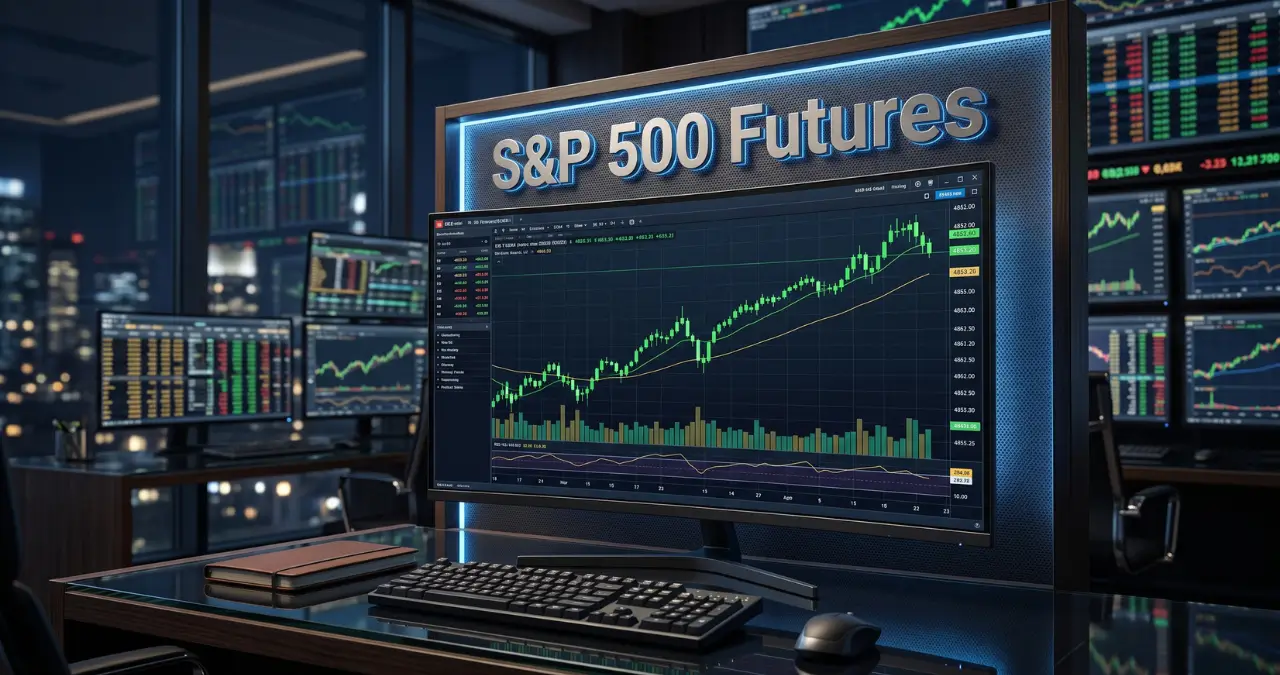
An S&P 500 future is a standardized contract that lets traders take a position on the future value of the S&P 500 index without owning any of the 500 underlying stocks. These contracts trade on the Chicago Mercantile Exchange under the ticker ES, with a smaller version called the Micro E-mini trading under MES, and both settle in cash rather than delivering any physical shares.
If you’ve seen “S&P 500 futures” quoted on financial news before the stock market even opens, this guide explains exactly what that number represents, how the contracts are structured, and what you’d actually need to know before trading one. This is educational information, not investment advice — futures carry significant risk and aren’t suitable for every investor.
What Is an S&P 500 Future?
An S&P 500 future is a cash-settled derivative contract based on the future value of the S&P 500 index, traded electronically on the CME Globex platform. Unlike buying shares of an S&P 500 index fund, a futures contract doesn’t give you ownership of anything — it’s an agreement to settle a cash difference based on where the index lands relative to your entry price.
The current standard contract is the E-mini S&P 500, ticker symbol ES, introduced by the CME in 1997. A smaller Micro E-mini version, ticker MES, launched later at one-tenth the size, making futures exposure accessible to traders with smaller accounts. The original full-size S&P 500 futures contract, simply ticker SP, was delisted in September 2021, so ES is now effectively the standard contract most traders mean when they say “S&P 500 futures.”
How S&P 500 Futures Contracts Are Structured
Each E-mini S&P 500 futures contract has a $50 multiplier, meaning the contract’s dollar value equals 50 times the index level, while the Micro E-mini carries a $5 multiplier at one-tenth that size. A one-point move in the underlying index is worth $50 on an ES contract and $5 on an MES contract, which is the core math behind every profit or loss calculation on these instruments.
The minimum price movement, or tick size, is 0.25 index points on both contracts. That translates to $12.50 per tick on ES and $1.25 per tick on MES. Understanding this tick value matters directly for risk management — it’s the smallest unit any price change can register in, and it’s what determines exact profit or loss on a trade down to the cent.
Contract Symbols and Expiration Months
S&P 500 futures contracts expire quarterly, in March, June, September, and December, and each contract’s ticker combines the root symbol with a month code and year code. The month codes for these quarterly cycles are H for March, M for June, U for September, and Z for December, so a contract like ESZ26 refers to the December 2026 E-mini S&P 500 contract.
Contracts settle in cash to the S&P 500 index’s official value on the third Friday of the expiration month. Traders who want continuous exposure typically “roll” their position from the expiring contract into the next quarterly contract shortly before expiration, since holding through settlement isn’t necessary or common for most active traders.
S&P 500 Futures Trading Hours
S&P 500 futures trade nearly around the clock, from 5:00 p.m. Central Time Sunday through 4:00 p.m. Central Time Friday, with a roughly one-hour daily maintenance break. This extended, nearly 23-hour schedule is one of the main reasons futures are widely quoted as an overnight indicator of stock market sentiment — they keep trading long after the regular 9:30 a.m. to 4:00 p.m. Eastern stock market session closes.
That extended access is genuinely useful context for a specific, common scenario: major economic data, a surprise Federal Reserve announcement, or unexpected geopolitical news hitting after the stock market closes. S&P 500 futures react to that news in real time overnight, which is exactly why financial news shows quote “futures are up” or “futures are down” before the opening bell — they’re reporting what already happened in the futures market hours before regular trading resumes.
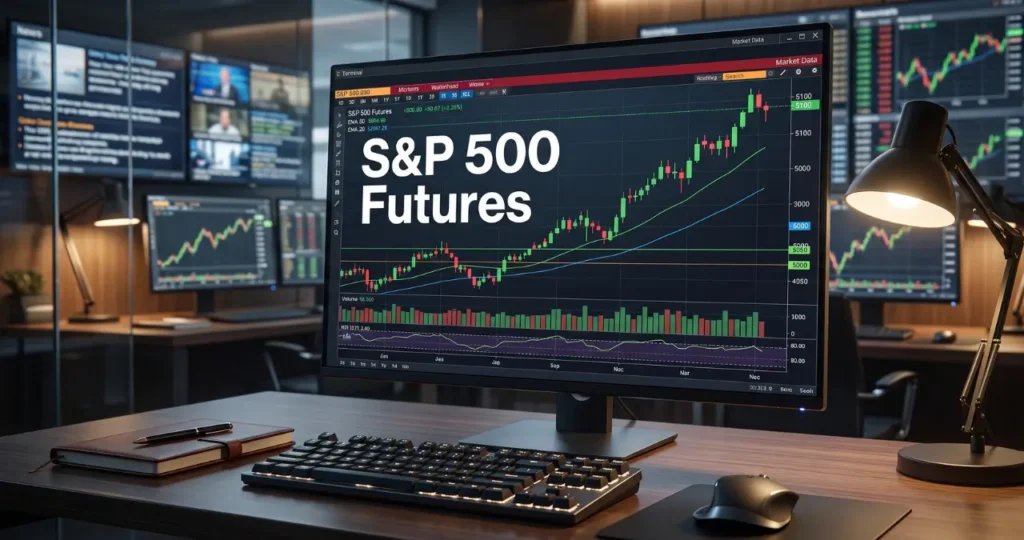
S&P 500 Futures vs. the S&P 500 Index
The S&P 500 index itself is simply a calculated number tracking the combined market value of 500 large U.S. companies, while S&P 500 futures are a tradable contract whose price moves in close correlation with that index but isn’t identical to it. The two numbers move together almost all the time, but a futures price can diverge slightly from the live index due to factors like interest rates, dividends expected before expiration, and time remaining until settlement — a relationship traders call the futures “basis.”
This distinction trips up a lot of people new to the topic: watching “S&P 500 futures” before market open isn’t the same as watching the actual index, since the cash index only calculates during regular stock market trading hours when its component stocks are actively trading. The futures price is effectively a continuously updated market forecast of where that index will likely open.
S&P 500 Futures vs. S&P 500 ETFs
S&P 500 futures and S&P 500 ETFs like SPY, IVV, and VOO both let you gain exposure to the same 500 companies, but they differ in leverage, trading hours, tax treatment, and capital efficiency. Futures require a fraction of the capital an equivalent ETF position would, because you’re posting margin rather than paying the full notional value — but that leverage cuts both ways, magnifying both gains and losses relative to the capital you’ve committed.
This is the comparison most generic explainers skip past too quickly. ETF shares trade only during standard market hours (with limited pre/post-market exceptions), while futures trade nearly 24 hours across five days. Futures also fall under Section 1256 tax treatment in the U.S., which splits gains between 60% long-term and 40% short-term capital gains rates regardless of how long the position was actually held — a materially different tax outcome than typical stock or ETF trading, where holding period alone determines the rate. None of this makes one option inherently better than the other; it depends entirely on your time horizon, tax situation, and risk tolerance, which is exactly the kind of decision worth discussing with a financial or tax professional rather than deciding from a blog post.
Margin Requirements for S&P 500 Futures
Margin to hold an E-mini S&P 500 futures contract overnight typically runs in the range of $13,000 to $15,000 as of 2026, set and periodically adjusted by CME Group based on market volatility. This overnight, or “initial,” margin is a good-faith deposit rather than a loan, and it’s meaningfully different from the margin used to buy stocks on credit.
Day-trading margin is a separate, much lower figure — often $500 to $2,000 per ES contract, set by individual brokers rather than the exchange, based on the assumption that the position closes before the extended overnight session begins. The Micro E-mini’s margin requirements scale down proportionally, roughly one-tenth of the standard contract’s figures, which is precisely why MES has become the more common entry point for individual traders testing futures for the first time.
How to Read an S&P 500 Futures Quote
Reading an S&P 500 futures quote means looking at the current traded price alongside the point change and percentage change from the prior settlement, the same basic structure as a stock quote. A quote showing “ES 6,650.25, +12.50 (+0.19%)” means the current contract price sits at 6,650.25, up 12.50 points from the previous settlement — a move worth $625 per contract at the $50 multiplier.
Financial data providers and pre-market news segments typically report the point and percentage change specifically to give a quick read on expected market direction before the cash market opens. It’s worth remembering this reflects futures market sentiment specifically, not a guarantee of where the actual index will open once regular trading begins — the two can and sometimes do diverge in the minutes after the opening bell.
Frequently Asked Questions
What is an S&P 500 future?
An S&P 500 future is a cash-settled futures contract traded on the CME that lets traders take a position on the future value of the S&P 500 index without owning the underlying stocks.
What ticker symbol is used for S&P 500 futures?
The standard S&P 500 futures contract trades under ticker ES (E-mini S&P 500), with a smaller Micro E-mini version trading under MES at one-tenth the size.
When do S&P 500 futures trade?
S&P 500 futures trade nearly 23 hours a day, from 5:00 p.m. to 4:00 p.m. Central Time Sunday through Friday, with a roughly one-hour daily maintenance break.
How much is one point worth on an S&P 500 futures contract?
One point equals $50 on a standard E-mini (ES) contract and $5 on a Micro E-mini (MES) contract, based on each contract’s fixed multiplier.
When do S&P 500 futures contracts expire? S&P 500 futures expire quarterly, in March, June, September, and December, settling in cash to the index’s value on the third Friday of the expiration month.
Are S&P 500 futures the same as the S&P 500 index?
No. The index is a calculated number based on 500 underlying stocks, while futures are a separate tradable contract that closely tracks the index but can diverge slightly due to interest rates and time until settlement.
How much margin do I need to trade S&P 500 futures?
Overnight margin for one E-mini contract typically runs around $13,000 to $15,000 as of 2026, while day-trading margin set by brokers is usually much lower, often $500 to $2,000.
What’s the difference between S&P 500 futures and an S&P 500 ETF?
Futures offer nearly 24-hour trading, higher leverage through margin, and different tax treatment under Section 1256, while ETFs trade only during standard market hours and are taxed based on holding period.
Why do people watch S&P 500 futures before the stock market opens?
Because futures keep trading overnight while the stock market is closed, they give an early read on how markets may react to news, earnings, or economic data released outside regular trading hours.
Can individual investors trade S&P 500 futures?
Yes, through a brokerage account approved for futures trading, though the leverage and risk involved mean it’s worth understanding margin requirements and consulting a financial professional before starting.