









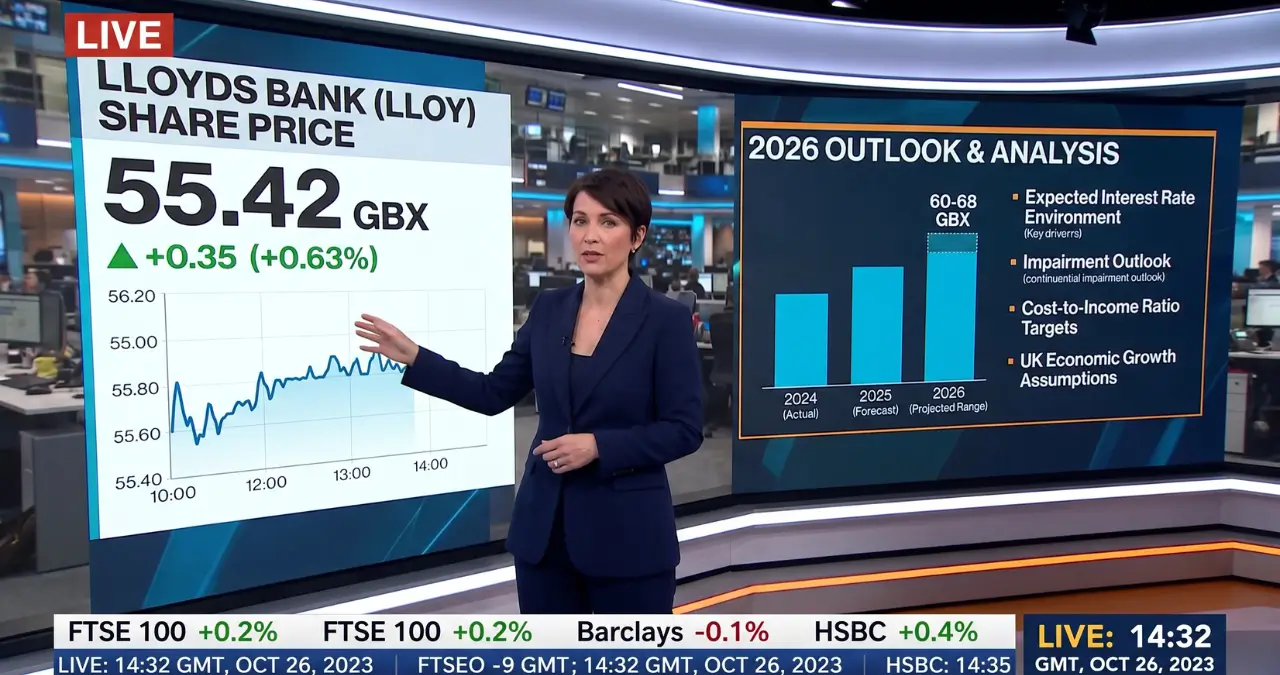
The latest verified London market close for Lloyds Bank share price data is 111.25 pence per share on 21 August 2026, after a 1.37% daily rise. The shares remain below their 52-week high of 118 pence, reached on 4 August 2026.
For investors, the bigger story is not just the daily price. Lloyds Banking Group reported a strong first half of 2026, increased its interim dividend by 30% and announced another £1 billion share buyback.
Important: “Lloyds Bank share price” usually refers to Lloyds Banking Group plc, listed on the London Stock Exchange under the ticker LLOY. The bank and the listed group are related but are not exactly the same corporate entity.
Lloyds Bank Share Price: Latest Update
The latest verified closing price available is 111.25p, or £1.1125 per share, based on the 21 August 2026 London close. The stock had traded as high as 118p during the recent 52-week period, meaning the latest close was about 5.7% below that high.
The recent price action has been fairly volatile. Lloyds closed at 114.70p on 17 August, fell to 112.75p on 18 August and 110.35p on 19 August, before recovering to 111.25p on 21 August.
That movement shows why investors should avoid judging LLOY solely from one day’s percentage change. Bank shares can react quickly to interest-rate expectations, economic data, credit conditions, regulatory developments and changes in investor expectations.
For anyone checking the Lloyds Bank share price before making an investment decision, the live market quote should be checked separately because the price changes during London trading hours.
Why Has the Lloyds Bank Share Price Been Strong?
Lloyds has benefited from stronger financial performance, improving returns and growing shareholder distributions. Its 2025 annual report said the share price increased by more than 79% during 2025, reflecting improved financial performance and stronger investor confidence.
The company’s 2026 performance has continued to provide support. In the first half of 2026, Lloyds reported £9.7 billion of net income, up 9% year on year, while statutory profit after tax reached £3.1 billion, up 23%. Return on tangible equity improved to 17.1%.
There are several reasons investors have been watching Lloyds closely:
- Stronger profitability
- Growth in lending and deposits
- Improving return on tangible equity
- Higher ordinary dividends
- Large share buyback programmes
- Continued cost-control measures
- A new 2027–2030 strategy focused on technology and productivity
These factors can support the valuation of a mature bank because investors are not only buying potential capital appreciation; they are also looking at dividends and share buybacks as part of total shareholder return.
Lloyds Banking Group 2026 Results
Lloyds’ first-half 2026 results were an important catalyst for investors because they provided a fresh view of earnings, capital strength and future shareholder returns.
The group reported £4.3 billion of statutory profit before tax for the first half, a 23% increase from the same period a year earlier. Total income increased 13% to £10.6 billion, while net interest income rose 10% to £7.1 billion.
The bank also reported underlying loans and advances of £491.5 billion, up 2% year to date, while customer deposits reached £500.9 billion, up 1%. Its pro forma CET1 ratio stood at 13.1% at the end of June.
Another useful measure is net interest margin, which was 3.19% in the first half of 2026. Net interest income remains an important part of Lloyds’ earnings because the group has a large UK banking franchise.
The results therefore provide a stronger fundamental backdrop than simply looking at the share chart.
Lloyds Bank Share Price and Dividend
The dividend is one of the main reasons investors follow the Lloyds Bank share price. Lloyds has a progressive ordinary dividend policy, although dividends are not guaranteed and future payments depend on the bank’s financial position and board decisions.
For the first half of 2026, Lloyds announced an interim ordinary dividend of 1.58p per share, representing a 30% increase from 1.22p in the first half of 2025. The payment is scheduled for 15 September 2026.
However, investors need to understand the ex-dividend date. Lloyds shares went ex-dividend on 6 August 2026, with 7 August as the record date. Therefore, someone buying the shares after the relevant ex-dividend date would not receive this particular interim payment.
For 2025, Lloyds’ total ordinary dividend was 3.65p per share, consisting of a 1.22p interim dividend and a 2.43p final dividend.
Dividend yield should not be viewed in isolation. A high yield can sometimes indicate that a share price has fallen because investors see greater risk. The more useful question is whether the company’s earnings and capital position can support future distributions.
Lloyds Share Buyback Programme
Share buybacks are another important part of the investment case.
Lloyds began a £1.75 billion ordinary share buyback programme in January 2026. By 30 June, it had repurchased approximately 1.2 billion shares for £1.2 billion, at an average price of 98.1p.
The bank then announced another buyback of up to £1 billion alongside its first-half results. That means the group is returning capital to shareholders through both ordinary dividends and share repurchases.
Buybacks can benefit remaining shareholders because reducing the number of shares in circulation can increase each remaining share’s proportion of the company, assuming the repurchases are made at sensible valuations and the underlying business remains healthy.
For investors analysing the Lloyds Bank share price, this is an important distinction: a share’s potential return does not come only from the market price rising.
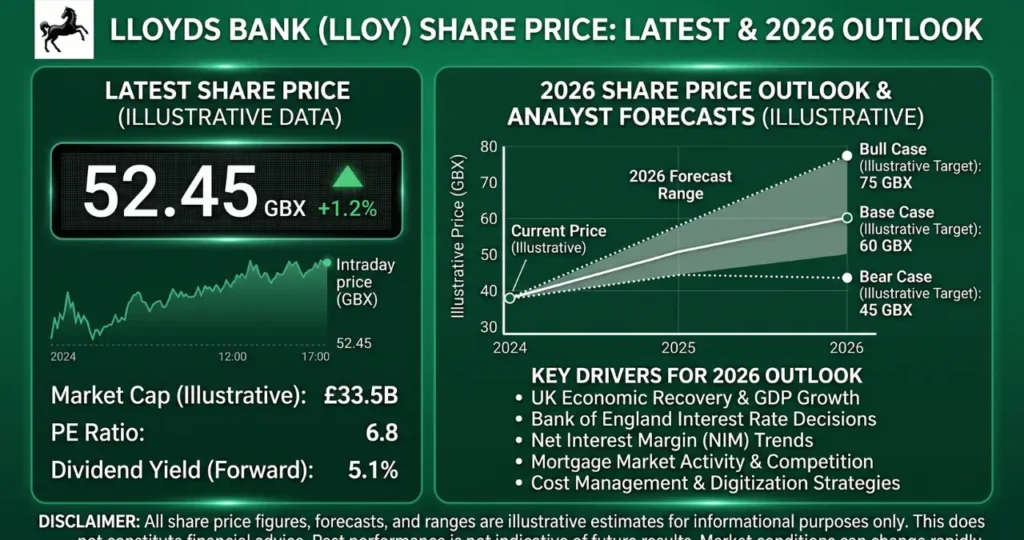
What Could Drive the Lloyds Bank Share Price Next?
The future direction of the Lloyds Bank share price will depend on several factors rather than one single event.
Interest Rates
UK interest rates influence banks through borrowing costs, deposit pricing and lending margins. Lloyds’ earnings are therefore sensitive to changes in the broader interest-rate environment.
Lower rates can reduce some lending margins, although they can also stimulate mortgage demand and wider economic activity. Higher rates can support lending margins in certain circumstances but may increase pressure on borrowers.
The effect is therefore more complicated than simply saying “higher rates are good for banks.”
UK Economy and Credit Quality
Lloyds has a predominantly UK-focused business model, so employment, house prices, consumer spending and business conditions matter.
If borrowers remain financially healthy, credit losses can remain controlled. If unemployment rises sharply or households and businesses struggle with debt repayments, banks may need to increase provisions for potential losses.
Mortgage Market
Lloyds is a major UK mortgage lender. The company’s own 2026 update said it remained the UK’s number-one mortgage lender and helped more than 30,000 first-time buyers purchase homes during the first half of 2026.
Mortgage demand and competition between lenders can therefore have a meaningful effect on future earnings.
Regulation and Motor Finance
Regulatory issues remain another risk. Lloyds’ 2025 annual report included an additional £800 million provision related to motor finance following its assessment of the FCA’s proposed redress scheme.
Investors should therefore monitor regulatory developments rather than assuming that all of Lloyds’ recent profit growth will translate directly into future shareholder returns.
Lloyds Banking Group’s 2030 Strategy
Lloyds has now moved into its next strategic phase, called Accelerate 2030.
The group says its 2027–2030 strategy aims for mid-single-digit income growth, a cost-to-income ratio below 45% by 2030, approximately 20% return on tangible equity and more than 225 basis points of capital generation.
Technology and AI are central to the plan. Lloyds expects a productivity step-change and around £2 billion in gross cost savings through areas including data, AI, modernised platforms and redesigned operations.
This creates an interesting long-term question for investors: can Lloyds convert its technology investment into sustainable earnings growth while maintaining strong credit quality and returning capital to shareholders?
That will matter more over several years than short-term daily movements in the share price.
Is Lloyds Bank Share Price Cheap or Expensive?
It is difficult to answer this using the share price alone. A price of 111p does not automatically mean that Lloyds is cheap simply because the number appears low.
Investors should compare the market price with measures such as earnings, tangible net assets, return on tangible equity, dividend expectations and the bank’s future capital generation.
At 30 June 2026, Lloyds reported tangible net assets per share of 57.0p.
That means the market price was substantially above reported tangible net assets per share. Whether that premium is justified depends on Lloyds’ ability to generate returns above its cost of equity and sustain those returns.
This is a better way to analyse a bank than comparing its share price with another company on a simple per-share basis.
Lloyds Bank Share Price Outlook for 2026
The 2026 outlook has improved in some respects because Lloyds entered the second half with strong first-half results, higher shareholder distributions and a clear strategic plan.
For 2026, the group continues to target underlying net interest income of more than £14.9 billion, a cost-to-income ratio below 50%, return on tangible equity above 16% and capital generation above 200 basis points.
The main bullish argument is straightforward: if Lloyds continues to grow income, control costs, maintain good credit quality and generate excess capital, the company has more capacity for dividends and buybacks.
The main risks are equally important. A weaker UK economy, higher credit losses, regulatory costs, mortgage competition or disappointing progress from the new strategy could pressure earnings and investor sentiment.
Therefore, rather than predicting one exact future price target, investors should watch whether Lloyds continues to deliver against its financial targets.
Lloyds Bank Share Price vs. Business Performance
One of the most useful lessons for investors is that the share price and business performance do not always move together in the short term.
A bank can report strong earnings while its shares fall if investors expected even better results. Conversely, shares can rise before earnings improve if the market anticipates stronger future performance.
For Lloyds, this makes the combination of profit growth, RoTE, capital generation, dividends, buybacks and credit quality more informative than the daily price alone.
The recent 2026 results illustrate this point. Lloyds reported stronger profits and increased shareholder distributions, yet the market response around the results was not simply a straight-line rise.
That is normal for a large listed company whose valuation already reflects investor expectations.
Should You Buy Lloyds Shares?
Whether Lloyds is a suitable investment depends on your objectives, risk tolerance and valuation assumptions. The company currently has several attractive characteristics, including strong UK market positions, improving returns, dividend growth and substantial capital distributions.
However, it is still a bank exposed to the UK economy, interest rates, credit losses, regulation and mortgage competition.
A sensible investor should therefore consider total shareholder return rather than asking only whether the share price will rise.
For example, someone focused on income may value Lloyds differently from a growth investor. The income investor may place greater weight on dividends and buybacks, while the growth investor may focus more heavily on earnings and the potential for the 2030 strategy to improve profitability.
The key question is not simply “Will Lloyds reach £1.20?” It is whether the expected future cash returns and earnings justify the price being paid today.
Lloyds Bank Share Price: Key Things to Watch
Investors tracking the Lloyds Bank share price should focus on these indicators:
- Net interest income — shows how the core banking operation is performing.
- Net interest margin — important for understanding lending profitability.
- Credit losses — rising losses can quickly affect bank earnings.
- Return on tangible equity — measures how effectively shareholder capital is being used.
- CET1 ratio — indicates capital strength.
- Dividend growth — important for income-focused investors.
- Share buybacks — can increase returns to remaining shareholders.
- UK mortgage performance — particularly important given Lloyds’ market position.
- Cost-to-income ratio — shows whether efficiency is improving.
- Progress toward the 2030 strategy — determines whether management’s longer-term targets are credible.
The next scheduled major reporting event is Lloyds’ Q3 interim management statement on 29 October 2026, according to the company’s financial calendar.
Frequently Asked Questions
What is the current Lloyds Bank share price?
The latest verified London close available for this article is 111.25p on 21 August 2026. The share price moves during London market hours, so investors should check a live market quote for the latest price.
What is the Lloyds share ticker?
Lloyds Banking Group plc trades on the London Stock Exchange under the ticker LLOY. The company is the listed group commonly referred to when people search for the Lloyds Bank share price.
Does Lloyds pay a dividend?
Yes. Lloyds has a progressive ordinary dividend policy. For 2026, the interim dividend was increased to 1.58p per share, up 30% from the previous year, with payment scheduled for 15 September 2026.
When is the next Lloyds dividend?
The 2026 interim dividend is scheduled to be paid on 15 September 2026. The shares went ex-dividend on 6 August, so investors buying after that date would not qualify for this particular payment.
Is Lloyds doing a share buyback?
Yes. Lloyds announced a buyback of up to £1 billion in July 2026, in addition to the £1.75 billion programme announced earlier in the year.
Why is the Lloyds Bank share price important to investors?
The share price determines the market value at which investors can buy or sell LLOY shares. However, dividends and share buybacks are also important because they contribute to total shareholder return.
What affects the Lloyds share price?
Major influences include UK interest rates, mortgage demand, economic growth, credit losses, regulation, bank profitability, dividends, share buybacks and investor expectations about future earnings.
Is Lloyds a good dividend stock?
Lloyds can appeal to investors seeking dividend income because it has increased its ordinary dividend and also returns excess capital through buybacks. However, dividends are not guaranteed, so investors should assess the bank’s earnings and capital position rather than relying only on its historical payments.
What is Lloyds’ 2030 target?
Under its Accelerate 2030 strategy, Lloyds targets mid-single-digit income growth, a cost-to-income ratio below 45%, around 20% return on tangible equity and more than 225 basis points of capital generation by 2030.
When is Lloyds’ next major results update?
Lloyds’ financial calendar lists its Q3 interim management statement for 29 October 2026.
Is the Lloyds Bank share price guaranteed to rise?
No. Even with strong earnings, dividends and buybacks, the share price can fall because of economic conditions, market sentiment, regulatory developments or changes in investor expectations. Past performance does not guarantee future returns.