









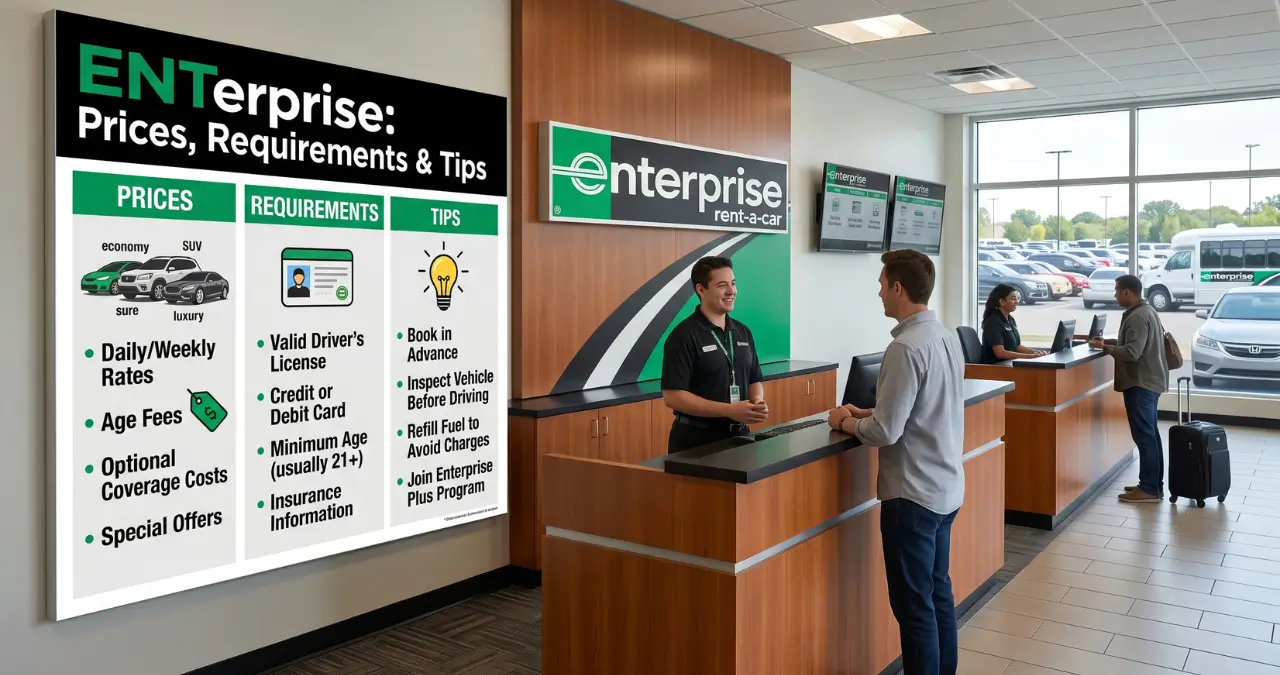
If you are searching for enterprise car rental, you are probably comparing prices, checking whether you qualify, or trying to understand what you will actually pay at pickup. Enterprise Rent-A-Car offers rentals across the United States and other markets, with options ranging from compact cars to SUVs, vans and trucks.
The important point is that there is no single Enterprise rental price. Your final cost depends on the vehicle, location, dates, rental length, driver age, protection products, mileage rules, taxes and possible additional fees.
This guide explains how Enterprise rentals work, what you need to rent, how one-way rentals differ from standard bookings, and how to compare the real cost before confirming a reservation.
How Does Enterprise Car Rental Work?
Enterprise car rental works by letting you choose a pickup location, rental dates, vehicle class and return location before receiving a reservation price. Your final agreement can include the base rental rate plus taxes, optional protection products, young-driver charges, additional equipment and other location-specific fees.
Enterprise operates through airport and neighborhood branches, so the cheapest option is not always the most convenient one. Airport rentals can have additional charges, while a nearby neighborhood branch may offer a different rate or availability.
When comparing a reservation, look beyond the headline daily rate. A $40-per-day vehicle can cost more overall than a $45-per-day alternative if the first booking has higher fees, mileage restrictions or a less convenient return arrangement.
Before pickup, check:
- Pickup and return locations
- Rental dates and times
- Vehicle class
- Mileage allowance
- Taxes and surcharges
- Young-driver fees, if applicable
- Optional protection products
- Additional-driver rules
- Deposit requirements
- Fuel and toll arrangements
Enterprise states that renters should also consider after-hours returns, toll roads, mileage restrictions, protection options and deposits before collecting the vehicle.
How Much Does Enterprise Car Rental Cost?
Enterprise car rental pricing varies by location, vehicle, dates and rental terms, so there is no reliable universal daily price. The most accurate price is the quote shown for your specific reservation because Enterprise changes rates according to market conditions and booking details.
For example, renting an economy car for several days from a neighborhood branch can have a very different total from renting an SUV at an airport during a busy travel period.
Your total may include:
- Base rental rate
- Taxes
- Location or airport fees
- Young-renter charges
- Additional-driver fees
- Optional protection products
- Extra equipment
- One-way or drop charges
- Mileage charges where applicable
- Fuel or toll-related charges
Enterprise says optional protection pricing varies according to the vehicle and other factors, so renters should check the specific reservation for accurate pricing.
Does Enterprise Have Unlimited Mileage?
Enterprise offers unlimited mileage on most car classes in the United States and Canada, but it is not universal. Larger and specialty vehicles can have mileage limits and additional charges for miles beyond the permitted allowance.
Enterprise specifically notes that large passenger vans, large cargo vans, large SUVs and exotic cars can have limited mileage. The additional-mile rate can vary by vehicle and reservation.
This matters if you are planning a long road trip. Always check the mileage terms attached to the exact vehicle you are booking rather than assuming every Enterprise rental includes unlimited miles.
What Do You Need for Enterprise Car Rental?
In the United States, Enterprise generally requires a valid driver’s license, acceptable identification and an accepted payment method, while age and other requirements depend on the rental location. Renters under 25 may face additional restrictions or a young-driver fee.
Enterprise’s U.S. requirements state that renters need a valid driver’s license with a photo, photo identification and an accepted credit or debit card.
The minimum age is generally 21 in the United States, although Michigan and New York have different minimum-age rules, and some government rentals have additional exceptions. Drivers aged 21–24 may be charged a young-renter fee depending on the location and rental circumstances.
Because requirements can vary, check the rules for the exact Enterprise branch before traveling to collect your vehicle.
Can You Rent From Enterprise Under 25?
Yes, drivers under 25 can rent from Enterprise in many U.S. locations, but additional fees and restrictions may apply. The standard minimum age is 21 in most of the United States.
Young renters should check the vehicle class carefully because some categories may have additional restrictions. The young-renter charge also varies by location, so it should be included in your cost comparison.
If you are 21–24, do not assume that the advertised rate is your final price.
Enterprise Car Rental One-Way Options
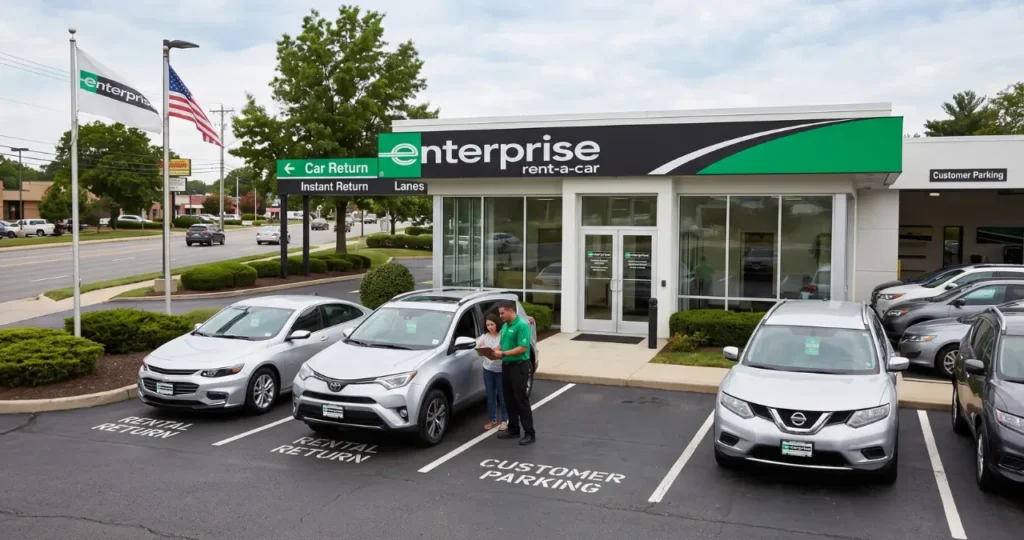
Enterprise car rental can be booked one-way at participating locations, allowing you to pick up a vehicle in one location and return it somewhere else. This can be useful for moving, road trips, business travel or flights departing from a different city.
Enterprise states that one-way rentals need to be booked in advance. Depending on the route, you may pay a one-time drop charge or mileage-related charge, and the one-way rate can be higher than returning the vehicle to the original branch.
For example, someone flying into one city and departing from another might prefer a one-way rental rather than driving back to the original branch. The convenience can save significant time even when the rental costs more.
The key is to compare the complete one-way price, not simply the daily rate.
Enterprise Car Rental at Airports vs. Neighborhood Locations
Airport and neighborhood Enterprise branches can produce different rental costs, so comparing both is worthwhile when your schedule allows it. An airport location may be more convenient, but convenience and pricing are not always the same thing.
An airport rental can make sense when you land with luggage and need a vehicle immediately. A neighborhood branch may be worth considering if you are already staying in the city and can reach the location easily.
When comparing the two, calculate:
- Rental price
- Taxes and location charges
- Transportation cost to the branch
- Opening hours
- Return convenience
- Available vehicle classes
The cheapest advertised rate is only useful if the location and rental conditions work for your trip.
Enterprise Car Rental Payment and Deposit Rules
Enterprise accepts several payment methods, but payment and deposit rules depend on the rental location and circumstances. Credit and debit cards can be accepted, while specific restrictions may apply to debit-card rentals.
Enterprise’s U.S. payment information explains that additional security deposits may be required and that renters should contact the location for the applicable deposit amount. Debit-card requirements can also include additional conditions, particularly at airport locations.
If you are relying on a debit card, do not assume that every branch follows identical procedures. Review the payment requirements for your specific pickup location before arriving.
Also make sure the card has enough available funds for the rental and any authorization or deposit that may be placed on it.
Is Enterprise Good for Road Trips?
Enterprise can be a practical choice for road trips, especially when your selected vehicle includes appropriate mileage and the pickup and return locations fit your route. The best option depends more on the trip requirements than on the brand alone.
For a normal road trip, an intermediate or full-size car may provide a useful balance between passenger space and fuel economy. A larger SUV can make more sense when you have several passengers or substantial luggage.
For long-distance travel, check mileage terms before booking. Enterprise says unlimited mileage is available for most vehicle classes in the U.S., but restrictions can apply to certain vehicles and one-way rentals.
A Simple Cost Comparison
Suppose two rentals both appear to cost roughly the same per day. One has unlimited mileage and a convenient return location, while the other has a mileage limit and a one-way charge.
For a short local trip, the second option might still work. For a 1,500-mile road trip, the first could provide better overall value.
This is why total trip cost matters more than the advertised daily rate.
Enterprise Car Rental Insurance and Protection
Enterprise offers optional protection products, but renters should understand what each product covers before deciding whether to purchase it. Protection pricing varies by vehicle, location and other rental factors.
Your existing auto insurance or credit-card benefits may provide some coverage, but that depends on your policy and circumstances. Never assume you are covered simply because you have personal car insurance or a credit card.
Before declining optional protection, check:
- Your personal auto insurance policy
- Your credit-card rental coverage
- Deductibles and exclusions
- Liability coverage
- Whether the rental vehicle type is covered
- Whether your trip location is covered
Enterprise advises customers to review available protection options and their costs during the reservation process.
For complicated coverage questions, your insurer or card provider is the appropriate source for confirmation.
How to Get Better Value From Enterprise Car Rental
The best way to reduce your rental cost is to compare the complete reservation rather than chasing the lowest advertised daily rate. Small differences in vehicle class, location, mileage and fees can change the final price.
Use this practical approach:
1. Compare multiple pickup locations
Check airport and neighborhood branches if both are realistic options.
2. Compare vehicle classes
Do not automatically choose the largest vehicle. A smaller car may cost less and use less fuel.
3. Check one-way charges
If you plan to return the car somewhere different, confirm the complete one-way price before booking.
4. Review mileage
Unlimited mileage is common for many standard vehicle classes, but verify the exact reservation.
5. Check age-related fees
Drivers under 25 should calculate any applicable young-renter charge.
6. Review protection separately
Do not compare one rental with optional protection included against another rental without checking what each price contains.
7. Inspect the agreement at pickup
Confirm the vehicle condition, fuel level, mileage and agreed rental details before leaving the branch.
Enterprise Car Rental vs. Other Rental Companies
Enterprise is worth comparing with other major rental companies based on total price, location convenience, vehicle availability and rental policies rather than brand name alone. Companies such as National and Alamo operate within the same broader Enterprise Holdings family, but their customer experiences and programs can differ.
For a simple local rental, branch proximity and price may matter most. For frequent business travel, loyalty benefits, corporate arrangements and airport availability can become more important.
For a road trip, mileage, one-way rules, vehicle size and return flexibility deserve more attention.
The right rental company is therefore the one that gives you the best combination of total cost, vehicle fit and practical convenience for that particular trip.
Enterprise Car Rental FAQ
1. What age do you have to be to rent from Enterprise?
In most U.S. locations, the minimum age is 21. Michigan and New York have different minimum-age rules, and renters under 25 may pay a young-renter fee.
2. Can I rent an Enterprise car with a debit card?
Yes, debit cards can be accepted, but additional conditions apply. Airport locations, for example, can require a ticketed return travel itinerary and other documentation.
3. Does Enterprise offer unlimited mileage?
Yes, unlimited mileage is available for most car classes in the U.S. and Canada. Some larger and specialty vehicles have mileage restrictions.
4. Can I return an Enterprise rental to another location?
Yes, participating locations can offer one-way rentals. Advance booking is required, and a drop or mileage charge may apply.
5. Does Enterprise charge a deposit?
A security deposit may be required in addition to the expected rental cost. The amount depends on the rental location and circumstances, so check directly with the branch.
6. Do I need insurance to rent from Enterprise?
You should review your existing insurance and the protection options offered with the rental. Coverage requirements and available products vary, so confirm what applies to your specific reservation.
7. Is Enterprise cheaper at an airport or local branch?
There is no universal winner. Compare the complete price at both locations, including taxes, surcharges and transportation costs to reach the branch.
8. Can I add another driver to an Enterprise rental?
Enterprise allows additional drivers when they meet the applicable requirements and are added to the rental agreement. Rules and fees can vary by location and rental type.
9. How can I find the cheapest Enterprise rental?
Compare different dates, vehicle classes and pickup locations, then evaluate the complete reservation price. Also check mileage, young-renter fees, one-way charges and optional protection.
10. What should I check before picking up my rental?
Bring the required identification and payment method, confirm the rental details, and review mileage, fuel, damage and return instructions. Enterprise specifically recommends considering mileage, tolls, protection products, deposits and after-hours returns before pickup.