




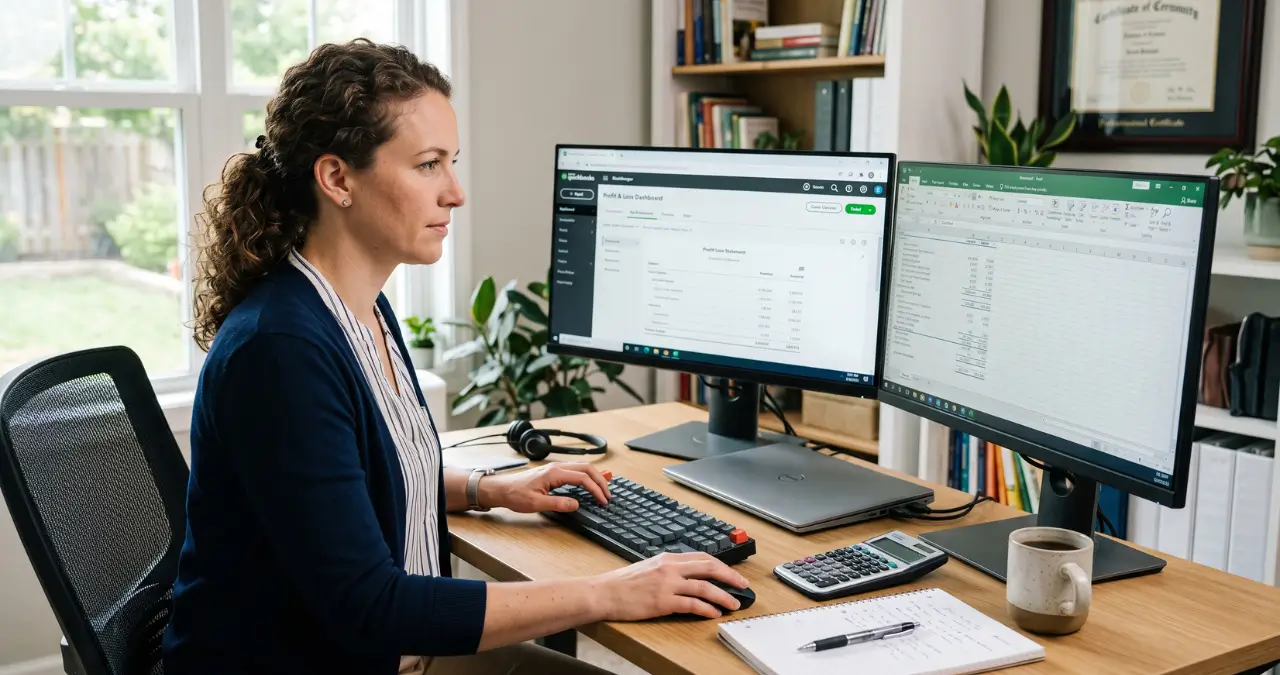
Remote bookkeeping jobs allow you to manage financial records, reconcile accounts, prepare reports, and support businesses without working from a traditional office. Many roles use cloud accounting platforms such as QuickBooks Online and Xero, making bookkeeping increasingly compatible with remote work.
For beginners, the field can be attractive because some employers accept a high school diploma or equivalent experience, while practical software skills can strengthen an application. However, bookkeeping is not simply data entry. Employers expect accuracy, financial awareness, confidentiality, and the ability to communicate clearly with clients or accounting teams.
This guide explains where to find remote bookkeeping jobs, which skills employers want, what the work involves, how much bookkeepers can earn, and how to build a competitive profile in 2026.
What Are Remote Bookkeeping Jobs?
Remote bookkeeping jobs involve maintaining a company’s financial records from a home office or another remote location. Typical responsibilities include recording transactions, reconciling bank accounts, managing accounts payable and receivable, and preparing financial reports.
The U.S. Bureau of Labor Statistics describes bookkeeping, accounting, and auditing clerks as workers who classify and record financial data, check records for accuracy, and reconcile differences. Bookkeepers may also handle invoices, payroll-related tasks, purchasing, and overdue accounts.
A remote bookkeeper might work directly for one company, support an accounting firm with multiple clients, or operate independently as a freelance bookkeeper.
Common job titles include:
- Remote bookkeeper
- Virtual bookkeeper
- Bookkeeping specialist
- Full-charge bookkeeper
- Accounting clerk
- Accounts payable specialist
- Accounts receivable specialist
- QuickBooks bookkeeper
- Bookkeeping assistant
The exact responsibilities depend on the employer and seniority level.
What Do Remote Bookkeepers Do?
Remote bookkeepers perform many of the same core duties as office-based bookkeepers, but they complete the work through cloud software, email, video calls, and online document systems. Their main responsibility is keeping financial information organized, accurate, and up to date.
Typical tasks include:
- Recording income and expenses
- Categorizing business transactions
- Reconciling bank and credit-card accounts
- Managing accounts payable
- Tracking accounts receivable
- Creating invoices
- Reviewing financial records
- Preparing profit-and-loss reports
- Maintaining general ledgers
- Investigating discrepancies
- Supporting month-end close
- Communicating with clients or accountants
For example, a small online retailer might send a remote bookkeeper access to its accounting software and bank feeds. The bookkeeper could categorize transactions, reconcile the accounts each month, identify missing documentation, and provide financial reports to the business owner.
The role becomes more valuable when the bookkeeper can identify unusual transactions rather than simply entering numbers.
Skills You Need for Remote Bookkeeping Jobs
The most important skills are bookkeeping fundamentals, accounting software proficiency, spreadsheet skills, attention to detail, and reliable communication. You do not necessarily need an accounting degree for every entry-level role, but you do need to demonstrate that you can maintain accurate financial records.
1. Basic Accounting Knowledge
You should understand concepts such as:
- Debits and credits
- Assets and liabilities
- Revenue and expenses
- Accounts payable and receivable
- Bank reconciliation
- General ledger
- Trial balance
- Profit and loss statements
- Balance sheets
Understanding why a transaction belongs in a particular account is more valuable than memorizing where to click in software.
2. QuickBooks Online
QuickBooks Online is an important platform to learn if you want to target small-business bookkeeping work. Intuit currently offers ProAdvisor training and certification programs, including QuickBooks Online certifications and bookkeeping-related training.
Certification is not a substitute for practical ability, but it can provide evidence of software knowledge when you have limited professional experience.
3. Xero
Xero is another major cloud accounting platform used by businesses and accounting professionals. Xero provides official advisor certification and badges designed to demonstrate knowledge of its products.
Learning both QuickBooks Online and Xero can make your profile more flexible because employers and clients may use different accounting platforms.
4. Excel or Google Sheets
Spreadsheets remain useful for cleaning data, checking transactions, creating calculations, and analyzing financial information. You should be comfortable with formulas, sorting, filtering, formatting, and basic data organization.
5. Communication and Confidentiality
Remote bookkeeping requires more than technical knowledge. You may need to ask clients about missing receipts, explain discrepancies, document decisions, and communicate deadlines.
Because bookkeepers handle sensitive financial information, reliability and confidentiality also matter.
How to Find Remote Bookkeeping Jobs
The best approach is to combine specialist accounting job boards, general remote-work platforms, company career pages, and freelance marketplaces. Do not depend on one website because bookkeeping opportunities appear under several different job titles.
Specialist and remote job platforms currently list bookkeeping, accounting support, accounts payable, accounts receivable, and related positions. Some remote-work resources specifically identify platforms such as AccountingFly, FlexJobs, We Work Remotely, Belay, and Upwork as sources for remote bookkeeping opportunities.
Search Using Multiple Job Titles
Searching only for “remote bookkeeper” can cause you to miss relevant opportunities.
Try searches such as:
- Remote bookkeeping
- Virtual bookkeeper
- Remote accounting clerk
- Remote accounts payable
- Remote accounts receivable
- QuickBooks bookkeeper
- Xero bookkeeper
- Remote bookkeeping assistant
- Junior bookkeeper remote
- Part-time remote bookkeeper
This strategy increases the number of relevant listings without changing your underlying career target.
Check Direct Employer Opportunities
Some companies hire bookkeeping professionals directly rather than through marketplaces. Intuit, for example, has a QuickBooks Live Bookkeeping program for remote bookkeeping experts and maintains a talent community for future opportunities.
Direct employer applications can be worthwhile because you can learn the company’s software requirements, working hours, eligibility rules, and hiring process before applying.
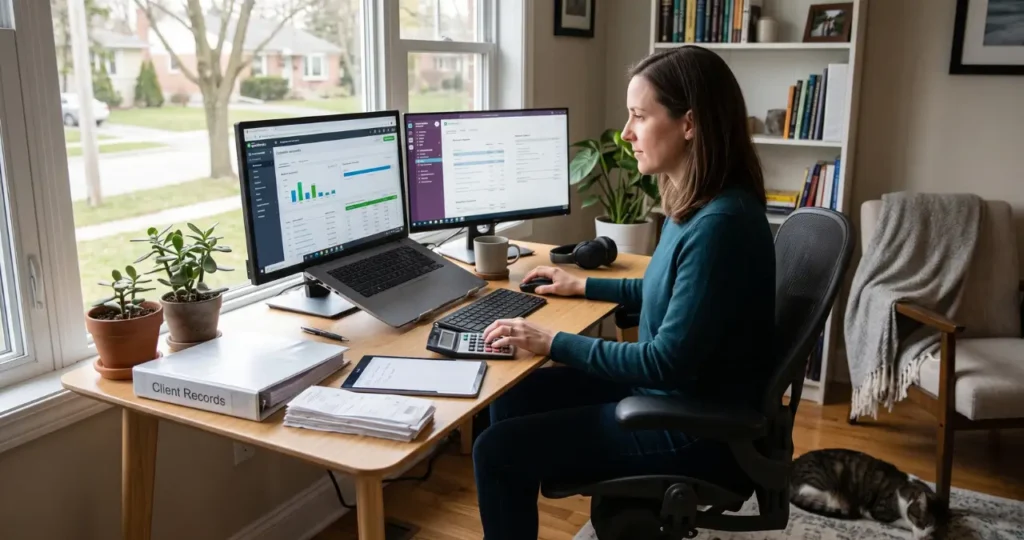
Remote Bookkeeping Jobs for Beginners
Entry-level candidates can find bookkeeping work, but having no experience means you need another way to demonstrate competence. A small portfolio, software certification, practice projects, and a targeted résumé can help fill that gap.
The BLS says entry requirements vary: some employers prefer college coursework or a degree, while others may hire candidates with a high school diploma. On-the-job training is also common.
A beginner can build practical evidence by creating sample projects such as:
- A fictional small-business chart of accounts.
- A month of sample transactions.
- Bank reconciliation examples.
- A sample profit-and-loss statement.
- Accounts payable and receivable records.
- A QuickBooks or Xero practice company.
The key is to label fictional data clearly. Never present practice work as experience with real clients.
How Much Do Remote Bookkeepers Make?
Remote bookkeeping pay varies considerably according to experience, location, employment type, responsibilities, and whether the worker is an employee or independent contractor. There is no single reliable salary figure that applies to every remote bookkeeping role.
For a useful benchmark, the U.S. Bureau of Labor Statistics reported a $49,210 median annual wage for bookkeeping, accounting, and auditing clerks in May 2024. The lowest 10% earned less than $34,600, while the highest 10% earned more than $72,660.
However, those figures cover the broader occupation and are not specifically remote-bookkeeping salaries.
The BLS also projects a 6% decline in employment for bookkeeping, accounting, and auditing clerks from 2024 to 2034. At the same time, it projects approximately 170,000 openings per year on average, largely because workers leave the occupation or retire.
That distinction matters. Automation is reducing some routine data-entry work, so candidates who can reconcile accounts, investigate discrepancies, understand accounting software, and provide useful financial information may be better positioned than candidates offering only basic data entry.
Remote Bookkeeping Jobs vs Freelance Bookkeeping
Both employment and freelancing can provide remote income, but they offer different trade-offs. A remote employee usually gets a defined role and workflow, while a freelancer must find clients, negotiate prices, manage deadlines, and handle client relationships.
| Factor | Remote Employee | Freelance Bookkeeper |
|---|---|---|
| Income structure | Salary or hourly pay | Client-based fees |
| Client acquisition | Usually handled by employer | Your responsibility |
| Schedule | Often defined by employer | More flexible |
| Workload | Usually assigned | You manage capacity |
| Business skills | Less important | Essential |
| Income scalability | More limited | Potentially higher |
| Stability | Generally more predictable | Can fluctuate |
For someone starting from zero, employment or contract work can provide useful experience. Freelancing can become more attractive once you can demonstrate consistent results and manage several clients efficiently.
How to Get Hired for Remote Bookkeeping Jobs
A strong application should show employers exactly what you can do rather than simply stating that you are “hardworking” or “detail-oriented.” Highlight accounting software, reconciliation, financial reporting, spreadsheet skills, and relevant experience.
Your résumé should emphasize measurable or specific capabilities such as:
Software: QuickBooks Online, Xero, Excel, Google Sheets
Bookkeeping: Bank reconciliation, transaction categorization, AP/AR, general ledger
Reporting: Profit and loss, balance sheet, account summaries
Remote work: Client communication, documentation, independent task management
If you lack professional experience, put relevant training and practical projects higher on the résumé.
Your application can also improve when you tailor it to the listing. If an employer specifically requests QuickBooks Online, mention your QuickBooks skills rather than sending the same generic résumé to every company.
Are Remote Bookkeeping Jobs Still a Good Career Choice?
Remote bookkeeping can still be a practical career path, but the safest strategy is to move beyond repetitive data entry. Accounting software continues to automate routine tasks, and the BLS specifically notes that technological changes are expected to reduce demand for some bookkeeping work.
That does not mean bookkeeping disappears. Instead, the work is shifting toward reviewing records, resolving discrepancies, analyzing information, and supporting business decisions.
A useful career progression could look like:
Bookkeeping assistant → Bookkeeper → Full-charge bookkeeper → Senior bookkeeping specialist → Accounting specialist or accountant
Adding skills such as payroll, financial reporting, tax-related support, industry-specific bookkeeping, or client advisory work can further broaden your opportunities.
How to Avoid Remote Bookkeeping Job Scams
Legitimate employers should not require you to pay large upfront fees simply to receive a job. Be particularly cautious when a supposed employer sends you a check and asks you to purchase equipment, transfer money, or send part of the funds elsewhere.
Other warning signs include:
- Unrealistically high pay for simple data entry
- Immediate hiring without a meaningful interview
- Requests for sensitive financial information too early
- Pressure to communicate only through unofficial channels
- Requests for upfront payment
- Vague company information
- Cryptocurrency or gift-card payment requests
- Job descriptions copied across unrelated companies
Verify the employer independently through its official website and career page before sharing sensitive information.
A Practical 30-Day Plan to Start
If you are starting from scratch, spend the first week learning bookkeeping fundamentals and double-entry accounting. During the second week, practice QuickBooks Online and spreadsheets, then begin learning Xero if your target jobs commonly request it.
During week three, create two or three clearly labeled bookkeeping portfolio projects and prepare a focused résumé. In the final week, apply consistently to relevant positions while improving your profile based on the requirements you repeatedly see.
A simple daily routine could include:
- 60 minutes of bookkeeping study
- 60 minutes of software practice
- 30 minutes improving your résumé or portfolio
- 30–60 minutes applying for suitable roles
Consistency matters more than sending hundreds of generic applications.
FAQ About Remote Bookkeeping Jobs
1. Can I get remote bookkeeping jobs with no experience?
Yes, some entry-level positions accept candidates with limited experience, particularly when they have relevant training and software skills. A practical portfolio can help demonstrate competence when you do not yet have professional clients.
2. Do I need a degree to become a remote bookkeeper?
Not always. The BLS notes that requirements vary by employer, with some employers accepting a high school diploma while others prefer college coursework or a degree.
3. Is QuickBooks certification worth getting?
It can be useful, especially when jobs specifically request QuickBooks Online. Intuit offers ProAdvisor training and certification options that can demonstrate software knowledge.
4. Should I learn QuickBooks or Xero first?
QuickBooks Online is a strong first choice if the jobs you are targeting frequently request it. Xero is also valuable, so learning both can broaden your potential client and employer pool.
5. Can bookkeeping be done completely remotely?
Yes. Cloud accounting platforms allow many bookkeeping tasks to be performed remotely, including transaction recording, reconciliation, reporting, and client communication. However, some employers may require specific working hours or occasional in-person responsibilities.
6. Are remote bookkeeping jobs available part-time?
Yes. Some businesses and accounting firms use part-time, contract, or freelance bookkeepers. Availability varies by employer, location, experience, and specialization.
7. Is bookkeeping difficult to learn?
The fundamentals can be learned without advanced mathematics, but accuracy and accounting concepts require practice. The BLS lists basic math, computer skills, analytical ability, and attention to detail among important qualities for the occupation.
8. Can I work remotely for a company in another country?
Sometimes, but it depends on the employer’s hiring rules, tax requirements, employment laws, time-zone needs, and whether the company accepts international contractors. Always check eligibility before applying.
9. What software should a beginner learn for remote bookkeeping jobs?
Start with QuickBooks Online, Excel or Google Sheets, and basic accounting principles. Xero is a useful additional platform, particularly when targeting employers or clients that use it.
10. Can bookkeeping become a long-term career?
Yes, but the strongest long-term path is to build skills beyond routine transaction entry. Experience with reconciliations, financial reporting, accounting software, specialized industries, and client advisory work can help you progress into more advanced accounting roles.