




The best small business ideas are not necessarily the most unusual ones. They solve a clear customer problem, match your skills and budget, and give you a realistic path to your first sale.
In 2026, entrepreneurs can choose from local services, online businesses, ecommerce, skilled trades, consulting, and AI-assisted services. Recent business guides also highlight digital marketing, technology services, ecommerce, virtual assistance, social media management, and AI-related services as active opportunities.
The key is to avoid choosing an idea simply because it is trending. Instead, compare startup costs, customer demand, competition, profit potential, and how easily you can test the idea before committing serious money.
25 Small Business Ideas to Consider in 2026
The strongest small business ideas generally fall into four groups: service businesses, online businesses, product businesses, and skilled local businesses. For beginners, service businesses often offer the simplest way to test demand because you can start without purchasing large amounts of inventory.
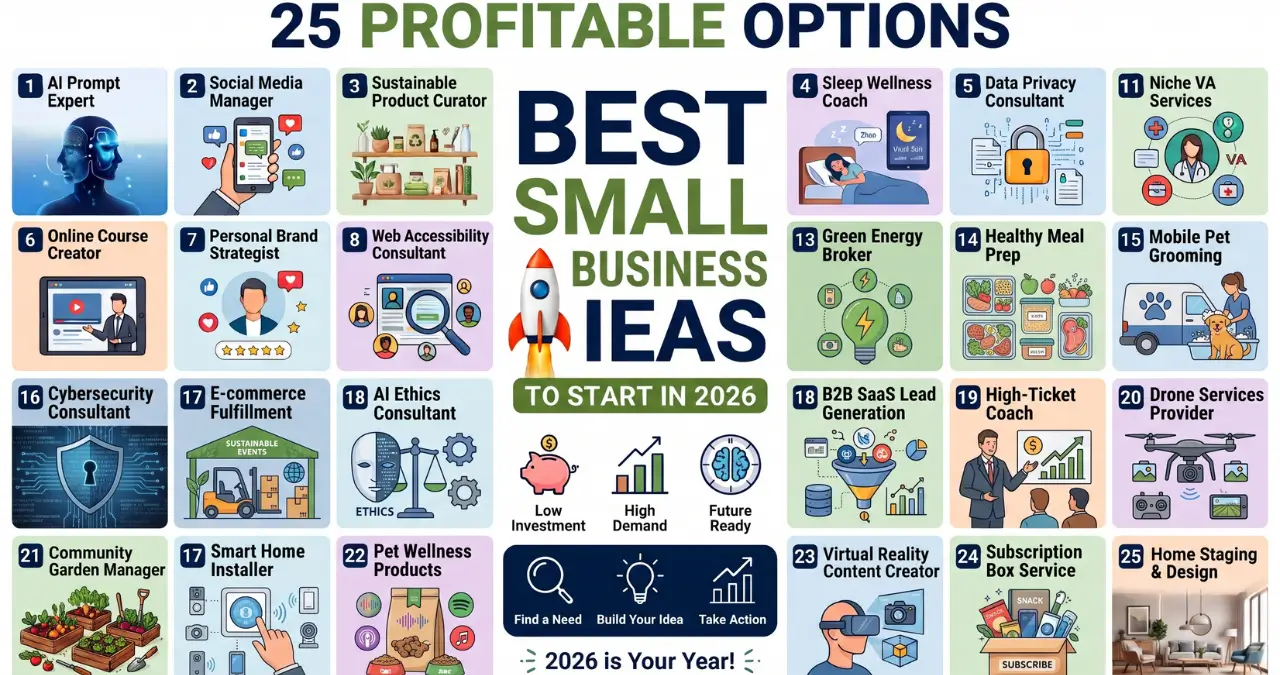
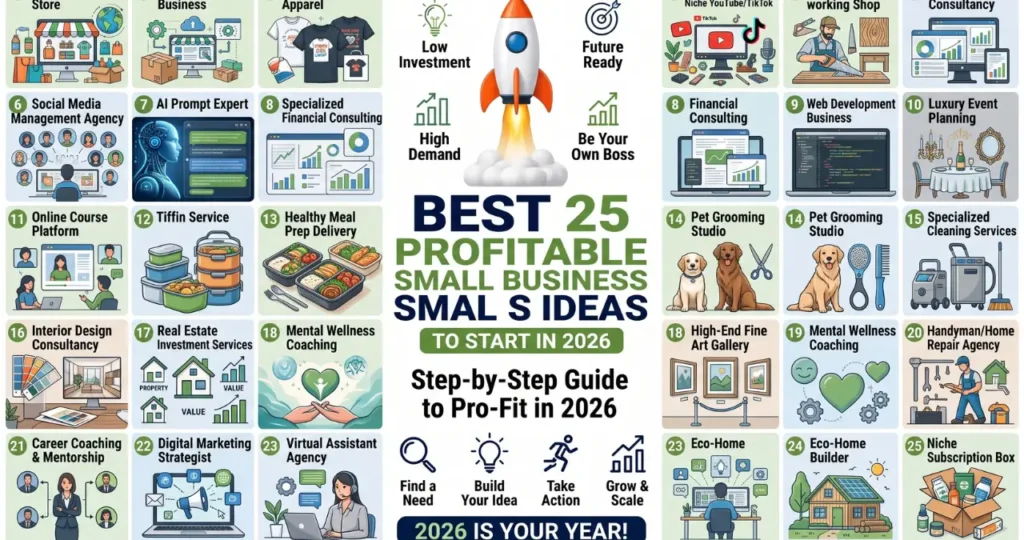
Here are 25 options worth considering:
| Business idea | Startup level | Potential advantage |
|---|---|---|
| Digital marketing service | Low | Recurring clients |
| Social media management | Low | Monthly retainers |
| Virtual assistant service | Low | Can work remotely |
| Website development | Low–Medium | High-value projects |
| SEO consulting | Low | Recurring revenue potential |
| Video editing | Low | Growing creator demand |
| AI implementation service | Low–Medium | Business productivity |
| Online tutoring | Low | Skill-based income |
| Online courses | Low | Scalable digital product |
| Niche ecommerce store | Medium | Product-based growth |
| Print-on-demand | Low–Medium | No large inventory |
| Home cleaning service | Low | Local repeat customers |
| Mobile car detailing | Medium | Local convenience |
| Lawn and garden service | Low–Medium | Repeat demand |
| Pet care service | Low | Local recurring customers |
| Handyman service | Medium | Practical local demand |
| Plumbing service | Medium–High | Skilled trade |
| Electrical service | Medium–High | Skilled trade |
| Phone repair | Medium | Everyday consumer need |
| Laundry service | Medium–High | Repeat purchases |
| Food delivery or catering | Medium | Local customer base |
| Bakery or specialty food | Medium | Product differentiation |
| Vending machine business | Medium–High | Semi-automated model |
| Photography service | Medium | Events and commercial work |
| Bookkeeping service | Low | Recurring business clients |
The table is a starting point, not a profitability guarantee. Your location, skills, pricing, competition, operating costs, and ability to acquire customers will determine the actual economics.
Best Small Business Ideas With Low Startup Costs
Low-cost small business ideas usually involve selling a skill rather than buying inventory. Digital services, tutoring, virtual assistance, consulting, content production, and certain local services can be started with relatively little equipment.
1. Digital marketing service
Digital marketing can include SEO, content strategy, email marketing, paid advertising, or local search optimization. A beginner should avoid selling everything at once and instead specialize in one measurable service for a specific type of customer.
For example, you could offer local SEO specifically to dentists, restaurants, contractors, or independent retailers.
2. Virtual assistant service
Virtual assistants help businesses with administrative work such as scheduling, research, customer communication, data entry, and basic operations.
The model becomes more attractive when you specialize. Instead of being a general assistant, you could focus on real estate administration, ecommerce support, or appointment management.
3. Video editing
Short-form video has created opportunities for editors who can turn existing footage into social media content. You can start by building sample projects and pitching a narrow customer group.
4. Online tutoring
If you have strong knowledge in mathematics, languages, science, software, or another subject, tutoring can become a straightforward service business.
The advantage is that customers are buying your expertise rather than a physical product.
5. Bookkeeping service
Small companies often need help organizing financial records and maintaining routine bookkeeping processes. This business requires appropriate knowledge and, depending on your jurisdiction and services, may have professional or regulatory requirements.
Best Online Small Business Ideas
Online small business ideas can reach customers beyond your local area, but they also expose you to global competition. The strongest models usually combine a specific audience with a clear problem rather than simply selling a generic online service.
6. Niche ecommerce store
A niche store focuses on a defined product category or customer group instead of attempting to compete with huge marketplaces.
Before buying inventory, investigate competitors, product pricing, customer reviews, and search interest. Shopify specifically recommends checking search trends, marketplaces, and negative customer reviews when validating an online business concept.
7. Print-on-demand business
Print-on-demand lets you sell designs on products such as clothing, posters, or accessories without holding large quantities of inventory yourself.
The challenge is differentiation. Generic designs face heavy competition, so a narrowly defined audience can be more useful than trying to appeal to everyone.
8. Online course business
An online course can turn specialized knowledge into a digital product. Good course topics usually solve a specific problem and promise a concrete learning outcome.
For example, “Excel for small retail businesses” is more targeted than simply “Learn Excel.”
9. Specialized consulting
Consulting works best when customers can clearly understand the outcome they are paying for.
Possible areas include marketing, operations, technology, sales processes, recruiting, or industry-specific expertise. Your credibility and results matter more than having a long list of services.
10. Software or micro-SaaS
A small software product can solve one repetitive business problem rather than attempting to become an all-purpose platform.
This has greater technical and development requirements than a simple service business, but software can potentially scale without adding customers at the same rate as labor-intensive services.
Small Business Ideas Using AI in 2026
AI-related small business ideas are increasingly practical when AI improves an existing service rather than becoming the entire selling point. Current small-business guidance identifies AI applications across marketing, customer service, operations, and sales.
11. AI automation service
Businesses often have repetitive tasks involving documents, customer inquiries, data organization, or internal workflows.
A small AI automation company could identify these repetitive processes and implement suitable tools. The value comes from saving time or reducing manual work—not from simply telling customers that AI is involved.
12. AI-assisted content service
Businesses need website content, social posts, product descriptions, newsletters, and other marketing materials.
AI can speed up research and drafting, while human editing, fact-checking, brand judgment, and quality control remain important.
13. AI customer-support setup
A specialized service could help small companies organize FAQs, knowledge bases, automated responses, and customer-support workflows.
The best opportunities are likely to involve businesses with repetitive questions and enough customer volume to benefit from automation.
Local Small Business Ideas With Repeat Customers
Local small business ideas can be particularly attractive when customers need the service repeatedly. Cleaning, lawn care, pet care, vehicle detailing, maintenance, and other convenience services can create recurring relationships.
14. Home cleaning service
Cleaning has a straightforward value proposition: customers pay to save time and avoid doing the work themselves.
You can start with a small service area and expand through referrals. Recurring weekly or monthly customers can make revenue more predictable than relying entirely on one-off jobs.
15. Mobile car detailing
Mobile detailing combines a practical service with convenience. Instead of requiring customers to drive to a shop, you bring the service to their home or workplace.
A useful strategy is to offer clearly defined packages rather than negotiating every job individually.
16. Pet care service
Dog walking, pet sitting, grooming, or related services can work well in areas with a large population of pet owners.
Trust is crucial, so reviews, reliable communication, clear policies, and professional presentation can become important competitive advantages.
17. Lawn and garden service
Lawn mowing, garden maintenance, trimming, cleanup, and seasonal services can generate repeat business in suitable markets.
You can begin with one service and add higher-value maintenance packages as the customer base grows.
18. Handyman service
Basic repair and maintenance services can serve homeowners, landlords, and property managers.
However, some construction and repair activities may require licenses or permits. Requirements vary considerably by location, so check local rules before offering regulated work.
Skilled Small Business Ideas
Skilled small business ideas can have strong economics because customers are paying for expertise that takes time to acquire. Electrical work, plumbing, equipment repair, and technical maintenance can also generate repeat referrals.
19. Electrical services
Electrical installation and repair can be valuable in residential and commercial markets, but this is a regulated trade in many jurisdictions.
Do not begin regulated electrical work without meeting the applicable licensing, training, and safety requirements.
20. Plumbing service
Plumbing can offer recurring demand because leaks, installations, repairs, and maintenance cannot always be postponed.
Like electrical work, licensing and permitting requirements depend on location and the specific work performed.
21. Phone and electronics repair
Screen replacement, battery replacement, software troubleshooting, and other repairs can serve customers who prefer repairing devices rather than immediately replacing them.
A strong location and transparent pricing can matter as much as technical ability.
How to Choose the Right Small Business Idea
The best small business ideas are those that fit your resources while solving a problem customers already pay to solve. Before spending money, test whether people actually want the product or service.
Use these five questions:
- Who is the customer?
Define a specific customer instead of saying “everyone.” - What problem are you solving?
The clearer the problem, the easier your marketing becomes. - What does the customer currently pay?
Research competitors and existing alternatives. - How much does it cost to deliver?
Include equipment, software, inventory, transport, advertising, taxes, licenses, and your time. - Can you get your first customer quickly?
A business that cannot generate early customer interest deserves more testing before major investment.
The U.S. Small Business Administration recommends market research, competitive analysis, business planning, and startup-cost calculations as core parts of evaluating a new business.
A Better Way to Compare Small Business Ideas
Instead of asking, “Which business is most profitable?” compare each idea using five practical factors: startup cost, demand, margin, repeat purchases, and scalability.
For example, a cleaning business may have modest startup requirements and strong repeat-purchase potential, but it depends heavily on labor. A software product may require more technical development but can potentially serve many customers without proportional increases in delivery costs.
This distinction is important because revenue potential and business quality are not the same thing.
A simple scoring system can help:
- Startup cost: 1–5
- Customer demand: 1–5
- Competition: 1–5
- Repeat revenue: 1–5
- Scalability: 1–5
- Your personal skill fit: 1–5
Score several ideas before choosing one. The highest total is not automatically the winner; an idea with strong demand and excellent skill fit may be better than one with theoretical scalability but no realistic route to customers.
How to Start a Small Business With Less Risk
Start by validating the offer before investing heavily in equipment, inventory, branding, or office space. Try to obtain real customer feedback, pre-orders, consultations, or paid pilot projects first.
A practical sequence is:
Choose a problem → define a customer → research competitors → create one offer → test demand → make the first sale → improve delivery → expand.
Your initial business plan does not need to be a huge document. The SBA notes that a lean startup plan can summarize the essential elements quickly, while more detailed plans may be appropriate when seeking financing.
You should also calculate your break-even point. The basic formula is:
Break-even units = Fixed costs ÷ (Selling price − Variable cost per unit)
This helps reveal whether your pricing and expected sales volume make sense before you commit significant capital.
Legal and Financial Considerations
The legal requirements for a new business depend on its location, structure, industry, and activities. Licenses, permits, taxes, insurance, registration, zoning, and business banking can all affect your startup requirements.
Do not assume that a home-based business is automatically exempt from local rules. The SBA notes that zoning requirements can still apply to home-based businesses, while licensing requirements vary according to business activity and location.
Keep business and personal finances organized from the beginning. Record startup expenses, recurring costs, sales, taxes, and customer payments so you can understand whether the business is actually profitable.
FAQ About Small Business Ideas
What are the best small business ideas for beginners?
Service businesses are often easier for beginners because they can require less inventory and allow you to test demand quickly. Digital marketing, tutoring, cleaning, virtual assistance, and local maintenance services are examples.
What small business can I start with little money?
Low-cost options include freelancing, tutoring, virtual assistance, consulting, content services, social media management, and some local services. Your main investment may be time and skill rather than inventory.
What is the most profitable small business?
There is no single universally most profitable business. Profit depends on pricing, demand, operating costs, competition, customer acquisition, and your ability to deliver the service efficiently.
Are online businesses better than local businesses?
Not necessarily. Online businesses can reach wider markets, while local businesses may benefit from geographic demand and repeat customers. The better choice depends on your skills, market, budget, and customer acquisition strategy.
What business can I start from home?
Many digital services, tutoring businesses, consulting practices, ecommerce models, content businesses, and administrative services can operate from home. Check local zoning, licensing, tax, and registration requirements first.
Is AI a good small business opportunity in 2026?
AI can create opportunities when it solves a genuine business problem. AI automation, customer-support systems, content workflows, and productivity services can be viable when customers can clearly see the value.
How do I know if a business idea will work?
You cannot know with certainty before testing it. Research competitors, identify potential customers, study pricing, validate demand, and try to make early sales before investing heavily.
How much money should I save before starting?
There is no universal amount. Calculate one-time startup costs, monthly operating expenses, expected personal expenses, and a realistic sales timeline. Then determine how much capital you need to operate without creating unnecessary financial pressure.
Should I write a business plan before starting?
Yes, but it does not need to be complicated. A lean plan covering customers, problem, solution, competitors, pricing, costs, sales strategy, and financial assumptions can help you identify weaknesses early.
What makes a small business sustainable?
A sustainable business usually has clear customer demand, sensible pricing, controlled costs, reliable operations, and a repeatable way to acquire customers. Recurring revenue can also improve predictability, but it does not guarantee profitability.