









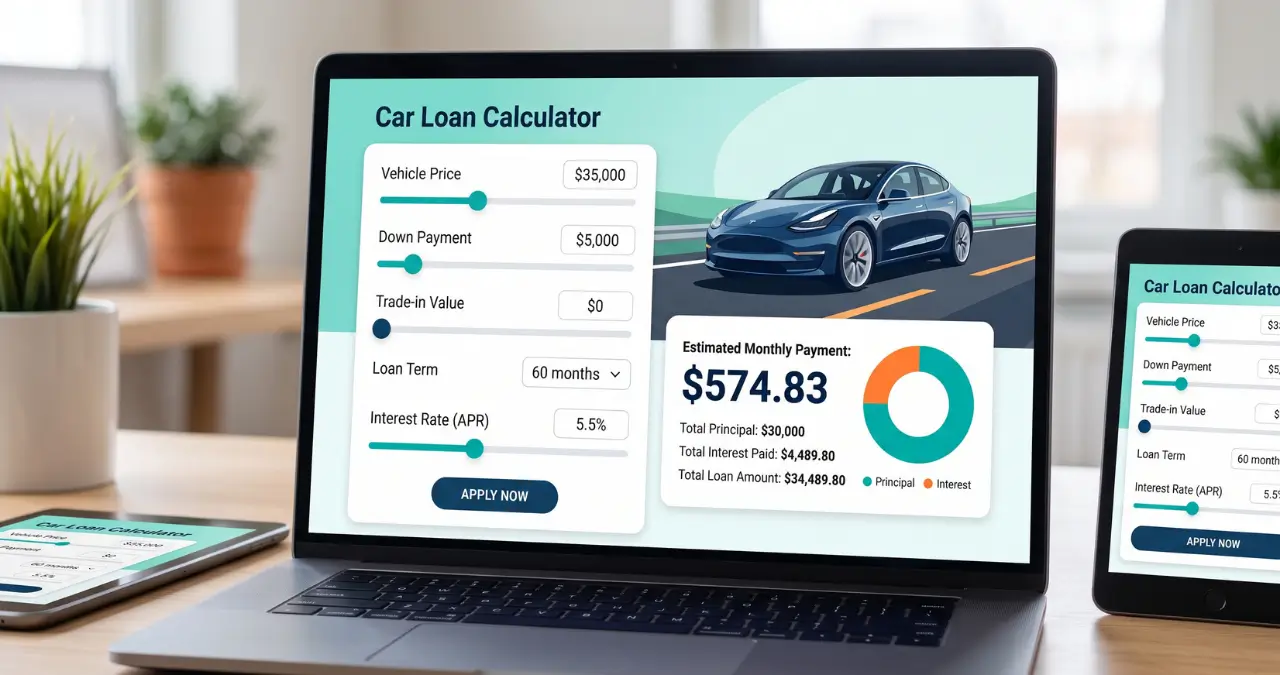
A car loan calculator helps you estimate how much you could pay each month for a vehicle and how much interest the loan may cost over time. By changing the loan amount, interest rate, loan term, and down payment, you can compare financing options before applying.
The monthly payment is only one part of the decision. A longer loan can reduce your monthly bill but increase the total interest you pay. A larger down payment can reduce the amount financed and may lower both your payment and overall borrowing cost.
This guide explains how auto loan payments work, how to use a calculator, what the results mean, and how to compare different financing scenarios.
How Does a Car Loan Calculator Work?
A car loan calculator estimates your monthly principal and interest payment using the amount borrowed, annual interest rate, and repayment term. Some calculators also account for a down payment, trade-in value, taxes, fees, or other financing costs.
For a standard installment auto loan, the payment calculation generally uses an amortization formula:
M = P × [r(1+r)ⁿ] ÷ [(1+r)ⁿ − 1]
Where:
- M = monthly principal and interest payment
- P = amount borrowed
- r = monthly interest rate
- n = total number of monthly payments
For example, suppose you finance $25,000 at a 7% annual interest rate for 60 months. The estimated principal-and-interest payment is about $495 per month.
That figure does not necessarily represent your complete monthly vehicle expense. Depending on the loan and location, you may also need to budget for sales tax, registration, insurance, fuel, maintenance, and lender fees.
What Information Do You Need?
Most calculators require four basic inputs:
- Vehicle price — The purchase price before adjustments.
- Down payment — Cash you pay upfront.
- Interest rate — The annual percentage rate charged by the lender.
- Loan term — How long you will take to repay the loan.
A trade-in can also affect the calculation. If you owe more on your current vehicle than its trade-in value, that negative equity can increase the amount you need to finance.
Car Loan Calculator: What Should You Enter?
For a useful estimate, enter the amount you actually expect to finance rather than simply entering the vehicle’s advertised price. Include applicable taxes, fees, and optional products only when you know they will be financed.
Consider this simplified example:
| Loan scenario | Amount financed | APR | Term | Approx. monthly payment |
|---|---|---|---|---|
| A | $25,000 | 7% | 48 months | $599 |
| B | $25,000 | 7% | 60 months | $495 |
| C | $25,000 | 7% | 72 months | $426 |
These figures illustrate an important trade-off. The 72-month loan produces the lowest monthly payment, but you make payments for longer and generally pay more interest than with the shorter options.
The exact result can vary if a lender uses different terms, fees, payment timing, or loan structures.
How Does a Down Payment Change the Calculation?
A larger down payment reduces the amount you need to borrow. That usually lowers the required monthly principal-and-interest payment and reduces the interest charged over the life of the loan.
For example, if you purchase a $30,000 vehicle and put $5,000 down, your starting financed balance could be substantially lower than if you financed the entire purchase price.
However, the exact amount financed can differ after taxes, fees, rebates, trade-in equity, and other adjustments.
How Much Car Can You Afford?
A car loan calculator can tell you whether a payment fits within a financing scenario, but it cannot determine whether the vehicle is affordable for your overall budget. Your decision should account for the complete cost of ownership.
Start with your monthly income and recurring expenses. Then consider:
- Loan payment
- Auto insurance
- Fuel or charging
- Maintenance
- Repairs
- Registration and taxes
- Parking or tolls
- Other debts and financial commitments
A $450 loan payment may look manageable in isolation. After adding insurance, fuel, maintenance, and other expenses, the vehicle could cost considerably more each month.
This is why focusing only on the payment can produce a misleading picture of affordability.
Why the Loan Term Matters
Loan terms often create a trade-off between monthly affordability and total borrowing cost.
A shorter term generally means higher monthly payments but fewer months of interest. A longer term generally lowers the monthly payment but can increase the total interest paid.
For example, using the earlier $25,000 loan at 7%:
- 48 months: about $599 per month
- 60 months: about $495 per month
- 72 months: about $426 per month
The payment difference can make a longer loan attractive. But compare the total amount repaid, not just the monthly figure, before choosing.

How Does the Interest Rate Affect a Car Loan?
The interest rate directly affects both the monthly payment and the total cost of borrowing. For the same loan amount and term, a higher APR generally produces a higher payment and more total interest.
Your offered rate can depend on factors such as credit history, income, loan amount, term, lender policies, and market conditions. Different lenders can offer different rates to the same borrower.
This makes comparison shopping important.
APR vs. Interest Rate
The annual percentage rate (APR) can provide a broader measure of borrowing cost because it can incorporate certain finance charges in addition to the stated interest rate, depending on the loan and applicable rules.
When comparing lenders, look at the APR, loan term, total finance charges, fees, and other contractual costs rather than comparing monthly payments alone.
How to Compare Two Car Loans
The best way to compare auto loans is to hold as many variables constant as possible. Compare the same amount financed and similar loan terms while examining APR, monthly payment, and total repayment.
Consider these two hypothetical offers:
| Loan A | Loan B | |
|---|---|---|
| Amount financed | $25,000 | $25,000 |
| APR | 6% | 8% |
| Term | 60 months | 60 months |
| Approx. payment | $483 | $507 |
Loan B costs roughly $24 more each month under these assumptions. Over 60 payments, that difference can become significant.
However, the cheapest loan is not always the one with the lowest advertised APR. Fees, optional products, prepayment terms, and other contractual details can affect the actual cost.
What Is the Difference Between a Car Loan Calculator and a Lease Calculator?
A car loan calculator estimates payments for financing a vehicle that you generally repay through scheduled installments. A lease calculator uses different inputs because leasing involves the vehicle’s expected residual value and other lease-specific factors.
With an auto loan, you typically borrow money and repay the principal plus finance charges over the agreed term.
With a lease, you generally pay for the vehicle’s use during a specified period rather than financing the full purchase price in the same way.
If you are deciding between buying and leasing, compare the total financial commitment rather than simply comparing the monthly payments.
What Does a Car Loan Calculator Not Tell You?
A car loan calculator provides an estimate, not a guaranteed loan offer. The actual terms you receive depend on the lender, your application, the vehicle, applicable fees, and the final loan agreement.
A calculator may also exclude expenses such as:
- Insurance
- Fuel
- Maintenance
- Registration
- Sales or value-added taxes
- Dealer or lender fees
- Extended warranties
- Service contracts
- GAP coverage
- Other optional products
Read the lender’s final disclosures carefully before accepting financing.
Why the Loan-to-Value Ratio Matters
The loan-to-value ratio, or LTV, compares the amount financed with the vehicle’s value. A high LTV can increase lending risk and may affect the terms available to a borrower.
A larger down payment can reduce the amount financed relative to the vehicle’s value.
Trade-in equity can have a similar effect. However, negative equity can work in the opposite direction if an outstanding balance from an old vehicle gets rolled into the new loan.
How to Lower the Cost of an Auto Loan
You can potentially reduce borrowing costs by comparing lenders, improving your credit profile where possible, making a larger down payment, and choosing a repayment term that fits your budget without unnecessarily extending the debt.
Before financing, consider these steps:
Compare Multiple Lenders
Get quotes from more than one lender when practical. Banks, credit unions, online lenders, and dealership-arranged financing may offer different terms.
Consider a Larger Down Payment
Putting more money down can reduce the principal you finance. That can lower both the monthly payment and total interest.
Choose the Shortest Comfortable Term
Do not choose a shorter loan solely to minimize interest if the payment would strain your budget. The right term balances affordability with total borrowing cost.
Avoid Shopping Only by Monthly Payment
A dealer can potentially make a payment appear lower by extending the loan term. Always ask for the total amount financed, APR, number of payments, and total repayment amount.
Can You Use a Car Loan Calculator Before Visiting a Dealer?
Yes. Using a car loan calculator before negotiating can help you establish a realistic financing range and understand how different prices, down payments, rates, and terms affect the payment.
For example, calculate several scenarios before shopping:
- Lower vehicle price with a larger down payment
- Same vehicle with a shorter term
- Different APRs
- Different trade-in values
- Different amounts financed
This gives you a clearer reference point when a dealer presents a financing proposal.
The key is to negotiate the vehicle price and financing terms separately when possible. A low monthly payment does not automatically mean you received a good deal.
Frequently Asked Questions
1. What is a car loan calculator?
A car loan calculator estimates the monthly payment and overall borrowing cost for an auto loan. You typically enter the loan amount, APR, and repayment term.
2. How accurate is a car loan calculator?
It can provide a reliable mathematical estimate when you enter accurate information, but it may not match your final lender offer. Taxes, fees, lender charges, and other costs can change the actual payment.
3. What is the formula for calculating a car loan payment?
For a standard amortizing loan, the payment can be calculated using the principal, monthly interest rate, and number of payments. The formula is M = P × [r(1+r)ⁿ] ÷ [(1+r)ⁿ − 1].
4. Does a bigger down payment lower monthly payments?
Usually, yes. A larger down payment reduces the amount financed, which generally reduces the required principal-and-interest payment and total interest.
5. Is a 72-month car loan a good idea?
It depends on your circumstances. A 72-month term can lower the monthly payment, but you may pay more interest and remain in debt longer than with a shorter term.
6. Does APR affect my monthly car payment?
Yes. Assuming the same amount financed and loan term, a higher APR generally produces a higher monthly payment and greater total interest.
7. Should I include taxes and fees in a car loan calculator?
Yes, if you expect to finance them. Entering only the vehicle’s sticker price can underestimate the amount you will actually borrow.
8. Can a car loan calculator calculate total interest?
Many calculators can. You can also estimate total interest by subtracting the original principal from the total scheduled principal-and-interest payments.
9. Does my credit score affect my car loan payment?
It can. Lenders may use credit history and other factors when determining whether to approve an application and what interest rate and terms to offer.
10. Should I compare car loans by monthly payment?
No. Compare APR, amount financed, loan term, total finance charges, fees, and total repayment. A lower monthly payment can sometimes result from a longer and more expensive loan.