








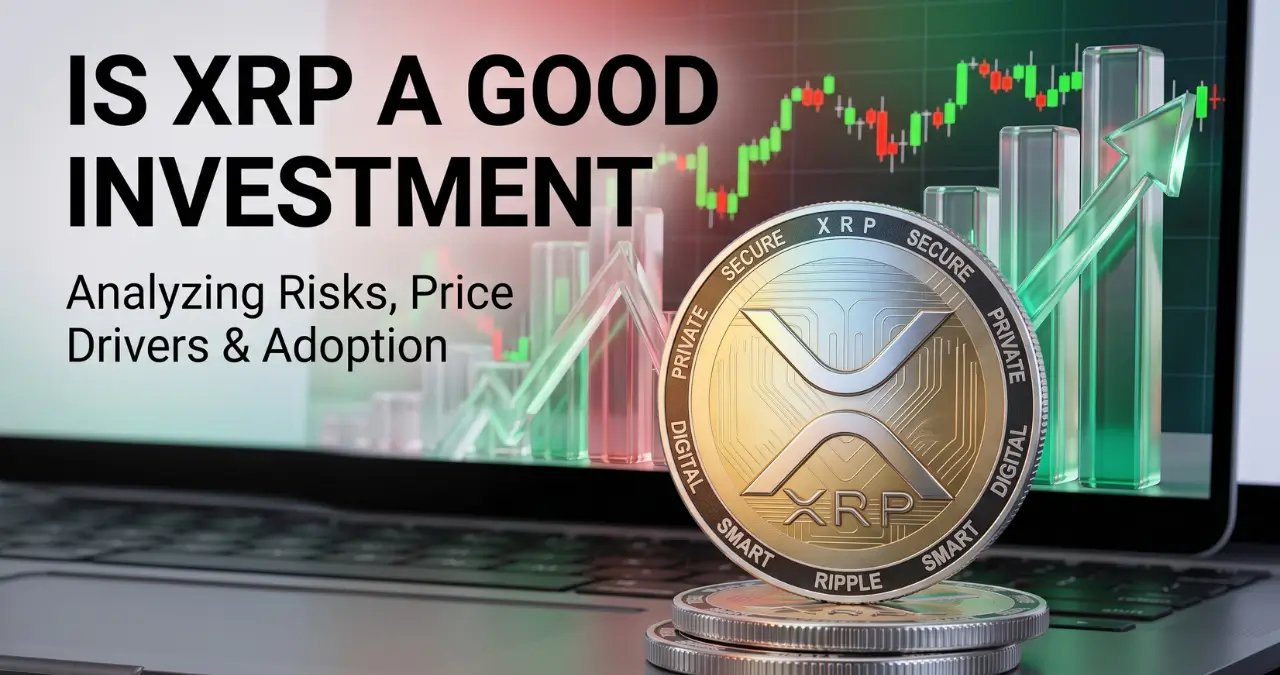
Whether XRP is a good investment depends heavily on your risk tolerance, since it’s a highly volatile asset that has swung more than 20% in a single day multiple times in August 2026 alone. XRP has cleared major regulatory hurdles that once scared off institutional buyers, but it also faces ongoing token dilution and stiff competition in the cross-border payments space it was built for. This isn’t financial advice, and nothing here should be read as a recommendation to buy or avoid XRP.
XRP currently trades in the $1.40 to $1.60 range as of late August 2026, with a market capitalization putting it among the top five or six cryptocurrencies by size. That price has moved dramatically in just the past week, which tells you a lot about what owning this asset actually feels like day to day.
Is XRP a Good Investment Right Now?
XRP is a legitimate but high-risk investment right now, sitting well below its all-time high despite years of positive regulatory news. The asset peaked at $3.65 in July 2025 and, as of late August 2026, trades roughly 55 to 60 percent below that level even after a sharp recent rally.
That gap matters. Ripple settled its long-running SEC case, spot XRP ETFs launched, and the company has expanded aggressively into banking and stablecoins — yet the price still hasn’t reclaimed its old high. One crypto analysis outlet put it bluntly: XRP “won everything it was supposed to win and fell anyway,” pointing to structural token dilution as the likely reason. That’s a genuinely important nuance most surface-level coverage skips.
Recent price action shows exactly how volatile this asset remains. XRP jumped roughly 20 to 40 percent over a few days in mid-to-late August 2026, driven by a mix of a Bitcoin short squeeze, a US Treasury bond-buyback announcement that pushed money back into riskier assets, and President Trump publicly pressing Congress to pass crypto market-structure legislation alongside Ripple’s CEO. None of that reflects steady, fundamentals-driven growth — it reflects a market that reacts fast and hard to news.
What Is XRP and How Does It Work?
XRP is the native digital token of the XRP Ledger (XRPL), a blockchain built in 2012 specifically to move money across borders quickly and cheaply. Transactions settle in three to five seconds for a fraction of a cent, compared with the minutes-to-hours and higher fees typical of traditional international wire transfers.
Ripple, the company most closely associated with XRP, uses the token to provide on-demand liquidity for payment corridors outside the US, letting financial institutions swap between currencies without holding pre-funded accounts in every market. The XRP Ledger also runs a built-in decentralized exchange and, since 2024, an automated market maker module for on-chain trading.
Importantly, XRP and Ripple the company aren’t the same thing, even though people often use the names interchangeably. Ripple holds a large XRP reserve and builds products around it, but XRP itself operates on an open, decentralized network that Ripple doesn’t fully control.
The Ripple vs. SEC Case: What Changed in 2025
The SEC’s lawsuit against Ripple, which alleged XRP sales constituted unregistered securities offerings, concluded in August 2025 after years of litigation. That resolution removed one of the biggest overhangs on XRP, since major US exchanges had delisted or restricted it during the case out of legal caution.
This is arguably the single biggest fundamental shift behind any “is XRP a good investment” conversation happening in 2026. Regulatory uncertainty had kept institutional money on the sidelines for years; once it lifted, exchanges relisted XRP, and asset managers began building products around it almost immediately.
XRP ETFs: What They Mean for Investors
Seven US spot XRP ETFs launched starting in September 2025, giving traditional investors a way to gain XRP exposure through a brokerage account instead of a crypto exchange. As of mid-2026, these funds collectively held just under 978 million XRP.
ETF access matters because it opens the door to retirement accounts, financial advisors, and institutions that generally won’t touch unregistered crypto exchanges. That said, roughly $1.5 billion in ETF inflows so far is a modest figure next to XRP’s tens of billions in market cap, meaning ETF demand alone hasn’t been enough to drive the price meaningfully higher on its own.
Some analysts point to pending legislation, particularly the CLARITY Act establishing clearer crypto market-structure rules, as the next major catalyst that could meaningfully expand ETF inflows if it passes.

XRP Price History and Current Volatility
XRP’s price history is a story of long stretches of stagnation punctuated by sudden, sharp moves. It launched in 2013 near fractions of a cent, hit an early peak near $3.84 in January 2018 during that year’s broad crypto bull run, then spent years trading well below that level before setting a new all-time high of $3.65 in July 2025.
Since that 2025 peak, XRP has fallen substantially, touching a cycle low near $0.99 in mid-August 2026 before rebounding sharply days later. That kind of swing, roughly 30 to 40 percent in either direction within weeks, isn’t an outlier for XRP; it’s closer to the norm.
Why Does XRP Keep Diluting Supply?
XRP’s supply grows every month because Ripple releases 1 billion tokens from escrow on the first of each month, typically re-escrowing 600 to 800 million and letting 200 to 400 million enter circulation. That steady dilution means XRP’s circulating supply keeps expanding even when demand doesn’t grow at the same pace.
This is worth understanding before treating any long-term XRP price target seriously. Circulating supply sat around 62.6 to 62.9 billion tokens in August 2026 and is projected by some analysts to reach somewhere between 73 and 84 billion by 2030. A price target that ignores this dilution is comparing today’s market cap against a much larger future token count, which quietly changes the math.
Arguments For Investing in XRP
The bull case for XRP centers on regulatory clarity, real payments utility, and Ripple’s aggressive corporate expansion. The SEC case is resolved, ETFs exist, and Ripple has spent roughly $4 billion acquiring companies like Hidden Road, GTreasury, Rail, Standard Custody, and Palisade to build out institutional infrastructure around XRP and its RLUSD stablecoin.
Ripple also secured conditional approval for a national trust bank charter and was reportedly valued at around $50 billion in a recent funding round, both signals that serious capital sees a long-term business here, not just a speculative token. RLUSD, Ripple’s dollar-backed stablecoin, crossed roughly $1.6 billion in market cap, giving the ecosystem a second growth lever beyond XRP’s price alone.
Arguments Against Investing in XRP
The bear case centers on structural dilution, unresolved competition, and a price that hasn’t rewarded years of good news. Even with the SEC case settled and ETFs trading, XRP sits far below its 2025 high, which raises a fair question about whether the “good news” was already priced in before it happened.
Competition is a real factor too. SWIFT, traditional correspondent banking networks, and other blockchain payment rails, including stablecoins on Ethereum and other chains, all compete for the same cross-border settlement use case XRP was built for. And because token dilution isn’t cosmetic, any long-term price recovery has to outrun genuine ongoing supply growth, not just match past highs on paper.
Volatility itself is also a legitimate risk on its own, separate from the fundamentals. An asset capable of moving 30-plus percent in either direction within days isn’t suited to money you can’t afford to see drop sharply, regardless of your long-term thesis.
Is XRP a Good Investment Compared to Bitcoin or Ethereum?
XRP serves a narrower, more specific purpose than Bitcoin or Ethereum, which changes how it should be evaluated against them. Bitcoin functions primarily as a store-of-value asset with a fixed 21 million supply cap, while Ethereum powers a broad smart-contract ecosystem; XRP is purpose-built for fast, cheap payment settlement.
That specificity cuts both ways. It gives XRP a clearer real-world use case than many altcoins, but it also ties its value more directly to Ripple’s business success and to whether banks and payment providers actually adopt XRP-based liquidity at scale, rather than to a broader, more diversified thesis like Bitcoin’s digital-gold narrative. XRP’s fixed maximum supply of 100 billion tokens is also far larger than Bitcoin’s, and unlike Bitcoin’s fully mined, disinflationary schedule, XRP’s monthly escrow releases add fresh supply every month.
How to Evaluate If XRP Fits Your Portfolio
Deciding whether XRP fits your portfolio comes down to your time horizon, risk tolerance, and how much weight you put on Ripple’s business execution versus pure price speculation. Given the volatility documented above, financial professionals generally suggest treating any single cryptocurrency as a small portion of a diversified portfolio rather than a core holding.
A few practical questions worth asking yourself: Can you tolerate a 30 to 40 percent swing in either direction within a matter of days? Are you investing based on Ripple’s actual payments and banking business, or mainly on price momentum? And have you accounted for ongoing token dilution in whatever long-term price expectation you’re working from? None of this tells you what to do, but answering honestly will tell you a lot about whether XRP suits your specific situation.
Frequently Asked Questions
Is XRP a good investment for beginners?
XRP’s volatility makes it a higher-risk choice for beginners compared with more established assets. Anyone new to crypto investing should understand the SEC case history, ongoing token dilution, and typical price swings before allocating meaningful money to it.
What is XRP’s all-time high price?
XRP’s all-time high is $3.65, reached in July 2025. As of late August 2026, it trades well below that level despite a recent sharp rally.
Did Ripple win its case against the SEC?
The Ripple v. SEC case concluded in August 2025, removing major regulatory uncertainty that had kept some US exchanges and institutions away from XRP.
Are there XRP ETFs available to US investors?
Yes. Seven US spot XRP ETFs launched starting in September 2025, giving investors a way to gain XRP exposure through a standard brokerage account.
Why does XRP’s price keep dropping even with good news?
Analysts point to ongoing token dilution, roughly 200 to 400 million new XRP entering circulation each month from Ripple’s escrow releases, as a structural headwind that offsets positive regulatory and business developments.
How volatile is XRP compared to Bitcoin?
XRP has historically shown sharper short-term price swings than Bitcoin, including recent moves of 20 to 40 percent within days, driven by a mix of crypto-specific news and broader macroeconomic events.
What is the CLARITY Act, and why does it matter for XRP?
The CLARITY Act is pending US legislation aimed at establishing clearer crypto market-structure rules. Some analysts estimate its passage could meaningfully increase institutional ETF inflows into assets like XRP, though it had not passed as of late August 2026.
Is XRP the same thing as Ripple?
No. XRP is the digital token that runs on the open XRP Ledger, while Ripple is the private company that holds a large XRP reserve and builds payment and banking products around it.
What drives XRP’s price the most right now?
Recent price action has been driven largely by broader crypto market sentiment, Bitcoin’s momentum, macroeconomic factors like Treasury bond buybacks, and regulatory news, more than by XRP-specific fundamentals alone.
Should I invest in XRP for the long term or trade it short term?
That depends entirely on your own goals and risk tolerance. Long-term holders need to account for ongoing supply dilution in their price expectations, while short-term traders need to be prepared for the kind of sharp, fast swings XRP has shown repeatedly through 2026.