









When people search for Kartik Ahuja growth marketing, they are usually looking for more than a definition of growth marketing. They want to understand who Kartik Ahuja is, what his marketing philosophy involves, which frameworks he uses, and whether those ideas can help businesses grow more efficiently.
Kartik Ahuja is a technology entrepreneur and growth marketing professional associated with startup growth, scalable marketing systems, funnel optimisation, and business automation. His public profiles identify him as a 3x founder, CEO and CFO, while his work has appeared through platforms including Entrepreneur.
The most useful way to understand his approach is not as a collection of isolated marketing tricks. It is better viewed as a system that connects acquisition, conversion, economics, automation, and customer value.
Who Is Kartik Ahuja?
Kartik Ahuja is a technology entrepreneur and growth marketing professional who focuses on customer acquisition, funnel optimisation, scalable marketing, and financial strategy. His public professional profile connects him with GrowthScribe and lists services including growth marketing, lead generation, marketing strategy, digital marketing, advertising, and conversion-focused work.
His background is particularly relevant because his content often connects marketing activity with business economics rather than treating traffic as the final objective. That distinction matters for startups and small businesses where every marketing dollar has to contribute to a measurable business outcome.
Ahuja has also published practical material about automation and operational efficiency. In an Entrepreneur article, he described using automation to offload 50% of his business tasks without increasing employee headcount. The article discusses tools including LinkedIn Sales Navigator, Apollo.io, QuickBooks Online, and HubSpot as part of his operational workflow.
It is important, however, to distinguish documented information from broad claims found on third-party websites. Numerous pages currently use the phrase “Kartik Ahuja growth marketing,” but some make detailed claims about his career or results without providing strong primary evidence. The most reliable picture comes from Ahuja’s own professional profiles, his published work, and established publications.
What Does Kartik Ahuja Growth Marketing Mean?
Kartik Ahuja growth marketing can be understood as a systems-oriented approach to growth that connects marketing, conversion, automation, and business economics. Instead of treating a campaign as the entire growth strategy, the emphasis is on improving the system that turns attention into customers and revenue.
This distinction is important because more traffic does not automatically create more growth.
Imagine a company receiving 10,000 monthly visitors but converting poorly. Increasing traffic to 20,000 visitors may double the number of people entering an inefficient funnel without fixing the underlying problem.
A stronger growth process asks several questions:
- Is the offer compelling?
- Is the target customer clearly defined?
- Does the landing page communicate value quickly?
- Where do prospects leave the funnel?
- What does customer acquisition cost?
- How much value does a customer generate?
- Which processes can be automated?
- Which acquisition channels can scale profitably?
Ahuja’s public marketing material reflects this broader view. His LinkedIn profile describes his work around converting websites and funnels, while his services include growth marketing, lead generation, advertising, and marketing strategy.
The practical lesson is simple: growth is a business system, not merely a traffic problem.
The Core Framework Behind Kartik Ahuja Growth Marketing
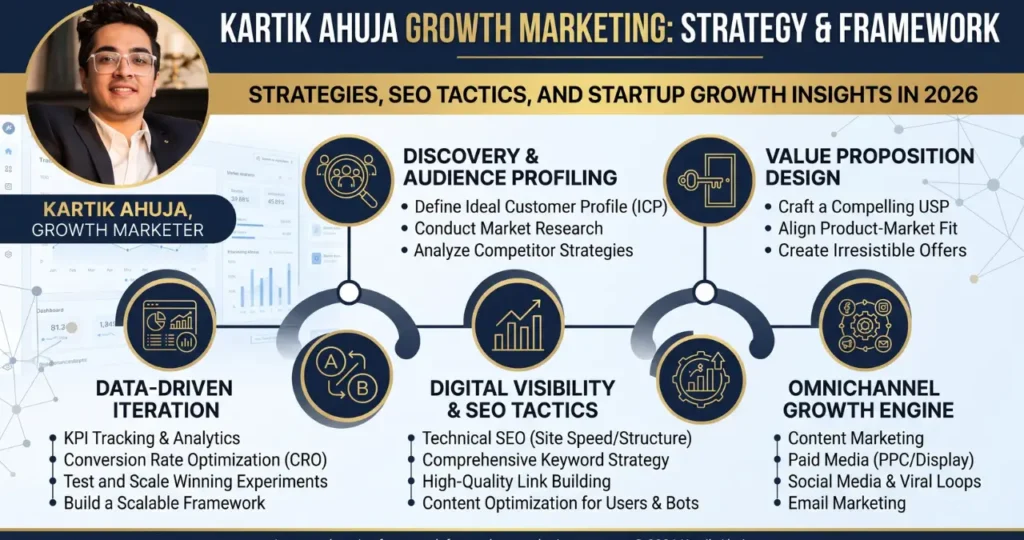
The most useful insight from Kartik Ahuja growth marketing is the importance of fixing the foundations before aggressively increasing acquisition. A marketing system can be viewed through four connected layers: economics, offer and messaging, conversion, and acquisition.
Ahuja publicly discussed this type of audit framework in a November 2025 article, describing a process that starts with unit economics, then examines offer and messaging, funnel and conversion, and finally traffic and acquisition.
1. Unit Economics
Before scaling marketing, a business needs to understand whether each customer can generate enough value to justify acquisition costs.
Important measurements include:
- Customer acquisition cost (CAC)
- Customer lifetime value (LTV)
- Average order value
- Gross margin
- Payback period
- Conversion rate
- Revenue per customer
For example, a business spending $100 to acquire a customer who generates only $70 in gross profit has a structural problem. Increasing the advertising budget does not solve it.
Unit economics therefore provides the financial foundation for growth.
2. Offer and Messaging
A strong acquisition system still struggles if customers cannot immediately understand why they should buy.
Offer design covers the value proposition, positioning, pricing, guarantees, bonuses, differentiation, and the specific problem being solved.
Messaging then communicates that value to the intended audience.
This is where marketing becomes partly psychological. A product can have excellent features but still perform poorly if customers do not understand the outcome those features create.
3. Funnel and Conversion
Once the offer is clear, the next question is what happens between the first interaction and the purchase.
A typical funnel might look like:
Ad or search result → Landing page → Lead form → Qualification → Sales conversation → Purchase
Every transition creates potential friction.
A company might have excellent advertising but lose prospects because the landing page is confusing. Another company might generate plenty of leads but waste sales resources because its forms do not qualify prospects.
Conversion optimisation therefore means finding and fixing specific points of leakage.
4. Traffic and Acquisition
Only after the previous layers make sense should businesses concentrate heavily on scaling acquisition.
Potential channels include:
- Search engine optimisation
- Paid search
- Meta advertising
- Email marketing
- Content marketing
- Partnerships
- Organic social media
- Referral programs
- Outbound sales
The right channel depends on the business model, audience, economics, and buying cycle.
That is a major difference between sustainable growth and channel chasing: the channel serves the economics rather than the other way around.
How Automation Fits Into the Strategy
Automation is an important part of Kartik Ahuja growth marketing because scalable growth can create operational bottlenecks. If every new customer requires the same manual work, revenue growth can increase workload almost as quickly as it increases income.
Ahuja’s published Entrepreneur article provides a concrete example. He described automating business processes to offload 50% of his tasks and avoid hiring additional employees for that workload. He also emphasised automating processes one at a time and measuring their impact rather than introducing too many tools simultaneously.
This is a useful principle beyond marketing.
Consider a lead-generation business. A manual process might require someone to:
- Find a prospect.
- Research the company.
- Enter information into a CRM.
- Send an outreach message.
- Follow up.
- Qualify the response.
- Schedule a call.
Automation can reduce repetitive work across several of these stages.
However, automation should not simply make a bad process faster. If the targeting is wrong or the messaging is weak, automation can increase the volume of poor-quality activity.
The better sequence is:
Understand → simplify → automate → measure → improve.
Acquisition vs. Conversion: Which Matters More?
Neither acquisition nor conversion is universally more important; the priority depends on where the bottleneck exists. A business with insufficient qualified traffic needs acquisition, while a business with plenty of traffic but poor conversion should usually fix the funnel first.
This provides a useful way to apply Kartik Ahuja growth marketing principles in practice.
| Situation | Likely Priority |
|---|---|
| Very little qualified traffic | Acquisition |
| High traffic, low conversion | Funnel optimisation |
| Strong conversion, poor margins | Unit economics |
| Good leads, weak sales close rate | Offer/sales process |
| Growing workload | Automation |
| Customers buy once and disappear | Retention |
This framework prevents a common mistake: solving every business problem with more advertising.
For example, suppose a SaaS company has 50,000 visitors but very few trial registrations. Spending more on Google Ads may increase visitors without materially improving revenue.
Changing the landing-page message, simplifying registration, improving onboarding, or clarifying the value proposition could have a larger effect.
What Marketers Can Learn From Kartik Ahuja
The biggest lesson from Kartik Ahuja growth marketing is to think in systems rather than isolated campaigns. Marketing performance becomes easier to improve when acquisition, conversion, economics, and operations are treated as connected parts of the same business.
Several practical lessons stand out.
Measure Business Outcomes
Traffic, impressions, clicks, and followers can be useful diagnostic metrics, but they are not always business outcomes.
A growth marketer should eventually connect marketing activity to qualified leads, customers, revenue, margin, and retention.
Test Before Scaling
A small experiment can reveal whether an idea deserves more investment.
For example, a company can test different headlines, offers, audiences, creatives, landing pages, or calls to action before committing a large budget.
Build Repeatable Systems
A campaign ends. A system can continue producing results.
That does not mean every marketing activity should become automated. It means successful processes should become easier to repeat, measure, and improve.
Keep Marketing Connected to Finance
The “best” marketing channel is not necessarily the one with the cheapest clicks. It is the one that can produce valuable customers at sustainable economics.
That is particularly important for startups where cash flow and customer acquisition costs can determine how quickly a company can scale.
How This Approach Compares With Traditional Digital Marketing
Traditional digital marketing often measures success at the campaign or channel level. Kartik Ahuja growth marketing is better understood as a broader operating model that connects marketing performance with the entire customer journey and the economics behind it.
Traditional approach:
Campaign → Traffic → Leads → Report
Growth-oriented approach:
Economics → Offer → Funnel → Acquisition → Conversion → Retention → Automation → Measurement
Neither model makes traditional marketing obsolete. Paid advertising, SEO, email, social media, and content remain useful.
The difference lies in how those channels are evaluated.
A campaign-focused marketer might ask, “How many leads did this campaign generate?”
A growth-focused operator asks, “Which customers did it generate, what did they cost, how many converted, how much revenue did they create, and can the process scale?”
That second question usually produces better strategic information.
Is Kartik Ahuja Growth Marketing Suitable for Startups?
Yes, the underlying principles can be especially useful for startups because startups usually have limited resources and need to identify efficient growth loops quickly. However, businesses should adapt the framework to their own product, market, customer journey, and financial constraints.
Startups should not copy someone else’s funnel simply because it worked elsewhere.
A B2B software company may need long sales cycles, demos, qualification, and account-based marketing. An e-commerce store may depend more heavily on product pages, paid media, email, repeat purchases, and merchandising.
The transferable principle is the process:
Find the bottleneck → form a hypothesis → run a test → measure the result → improve the system.
That is more valuable than copying any individual tactic.
Is Kartik Ahuja a Growth Marketing Expert?
Kartik Ahuja is publicly described by Entrepreneur as a “Tech Entrepreneur & Growth Marketing Expert” and as a 3x founder, CEO, and CFO focused on startup growth, scalable marketing, and financial strategy. His LinkedIn profile also lists growth marketing and marketing strategy among his services.
At the same time, readers should evaluate specific claims about results individually.
A credible profile does not automatically validate every statistic published on third-party websites. When researching Kartik Ahuja growth marketing, primary sources and established publications are more useful than pages that repeat the keyword without adding evidence.
What Is the Most Practical Takeaway?
The most practical takeaway from Kartik Ahuja growth marketing is to stop treating growth as a single-channel problem. Before increasing traffic, determine whether the economics, offer, funnel, and operational systems can support additional demand.
A simple audit can begin with five questions:
- Who is the highest-value customer?
- What problem makes them buy?
- What does it cost to acquire them?
- Where does the funnel lose prospects?
- Which repetitive processes prevent the business from scaling?
The answers can reveal whether the next investment should go toward advertising, SEO, conversion optimisation, sales, retention, or automation.
That is the real value of a systems approach: it helps a business spend resources on the constraint that matters most.
Frequently Asked Questions
1. Who is Kartik Ahuja?
Kartik Ahuja is a technology entrepreneur and growth marketing professional associated with startup growth, marketing strategy, funnel optimisation, and business automation. Entrepreneur identifies him as a 3x founder, CEO and CFO.
2. What is Kartik Ahuja growth marketing?
Kartik Ahuja growth marketing refers to a systems-oriented approach to business growth that connects unit economics, offers, messaging, conversion, acquisition, and operational efficiency.
3. What company is Kartik Ahuja associated with?
His public LinkedIn profile identifies GrowthScribe as his company and lists his professional services across growth marketing, lead generation, advertising, marketing strategy, and digital marketing.
4. What is the main idea behind Kartik Ahuja’s marketing strategy?
The central idea is to improve the complete growth system rather than relying on a single marketing channel. That includes understanding economics, strengthening the offer, improving conversion, and then scaling acquisition.
5. Does Kartik Ahuja focus on automation?
Yes. Automation features prominently in his published business content. In an Entrepreneur article, he explained how automation helped him offload 50% of his business tasks without hiring additional employees for that workload.
6. What metrics should growth marketers track?
Useful metrics include customer acquisition cost, customer lifetime value, conversion rate, revenue, gross margin, retention, payback period, and qualified lead volume. The right metrics depend on the business model.
7. Is growth marketing the same as digital marketing?
No. Digital marketing describes the broader use of online channels such as SEO, advertising, email, and social media. Growth marketing places greater emphasis on experimentation, measurable outcomes, conversion, retention, and the full customer journey.
8. Is this approach useful for small businesses?
Yes, the principles can apply to small businesses, but the implementation should match available resources. A small company may begin with a simple funnel audit, clearer positioning, better conversion tracking, and a few carefully chosen acquisition channels.
9. Does more traffic always mean more growth?
No. More traffic helps only when the business can convert and retain customers profitably. If the core offer or funnel is weak, increasing traffic can simply increase wasted marketing spend.
10. Where can I learn more about Kartik Ahuja?
The strongest starting points are his professional LinkedIn profile, his personal website, and his published work on Entrepreneur. These sources provide more reliable information than third-party pages that simply repeat the phrase “Kartik Ahuja growth marketing.”