






Conversion optimization services help businesses turn more of their existing website traffic into customers, leads, or sign-ups, without necessarily spending more on ads or SEO. Instead of driving new visitors, these services focus on getting more value out of the traffic a site already has, through testing, data analysis, and targeted changes to pages, forms, and checkout flows.
If you’re evaluating conversion optimization services for the first time, the offerings vary a lot between providers. This guide breaks down what’s typically included, what it costs, and how to tell a genuinely useful provider from one that’s just running random A/B tests and calling it strategy.
What Are Conversion Optimization Services?
Conversion optimization services are a structured, ongoing process of analyzing visitor behavior, forming hypotheses, and testing changes to improve how many visitors take a desired action on a website. That action might be a purchase, a signed-up trial, a form submission, or a completed booking, depending on the business.
The field is often called CRO, short for conversion rate optimization, and it sits somewhere between marketing, UX design, and data analysis. A conversion optimization service typically combines quantitative data (analytics, heatmaps, session recordings) with qualitative research (user surveys, usability testing) to figure out where visitors are getting stuck or losing interest.
It’s worth separating CRO from general web design. A redesign project usually ends when the new site launches. Conversion optimization is meant to be continuous, testing one hypothesis after another over months, because most meaningful improvements come from a series of smaller, validated changes rather than one big redesign.
What Does a Conversion Optimization Service Actually Include?
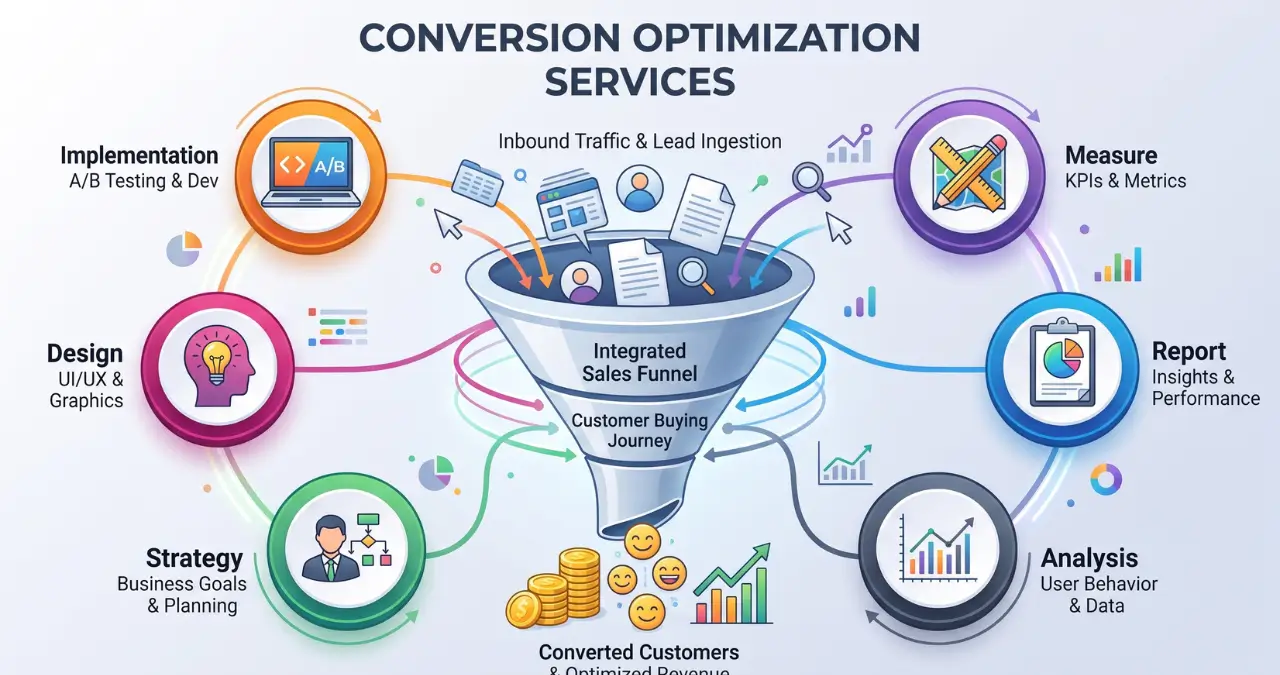
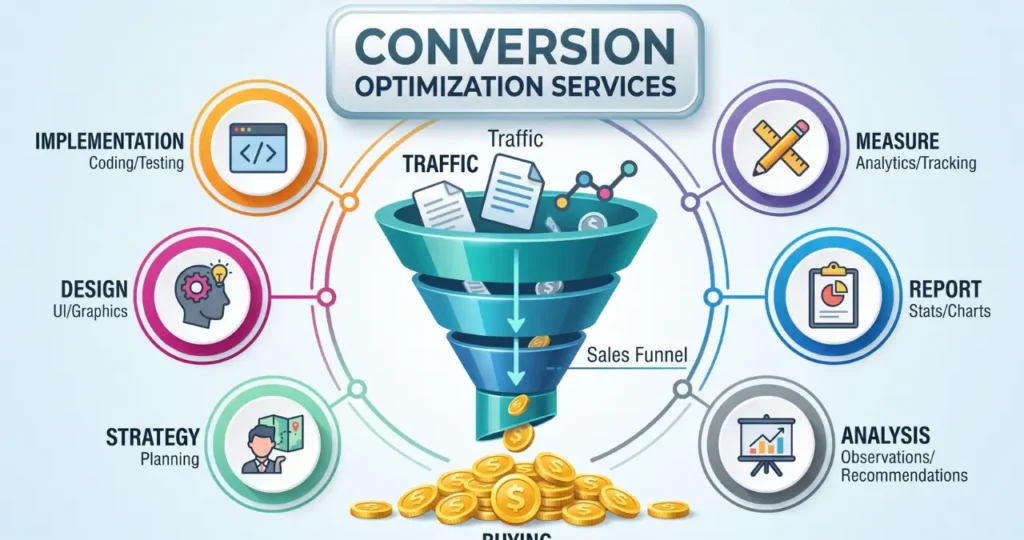
A typical conversion optimization service includes a data audit, hypothesis development, A/B or multivariate testing, and ongoing reporting on what worked. The exact mix depends heavily on the provider and the size of the engagement, but most legitimate services follow some version of this cycle.
Conversion Audits and Data Analysis
An audit is usually the starting point, and it should involve digging into existing analytics, heatmaps, and user recordings before recommending any changes. A competent provider will look at where visitors drop off, which pages have unusually high exit rates, and where the biggest gaps sit between different traffic sources.
This stage often surfaces obvious friction points that don’t even need formal testing to fix, like a broken mobile checkout button or a confusing form field. Providers who skip straight to “let’s test some headline variations” without this groundwork are usually guessing rather than working from evidence.
A/B and Multivariate Testing
A/B testing compares two versions of a page to see which one performs better, while multivariate testing checks multiple element combinations at once. Both require enough traffic volume to reach statistical confidence, which is one of the most commonly overlooked requirements in CRO work.
A page getting a few hundred visitors a month simply won’t generate reliable test results in a reasonable timeframe. A responsible conversion optimization service will tell a low-traffic client this upfront rather than running tests that will never reach significance, and will suggest qualitative research or straightforward UX fixes instead.
UX and Landing Page Optimization
Beyond formal testing, most services also review page structure, form design, load speed, and mobile usability, since these fundamentals affect conversion regardless of what specific copy or button color is being tested. A slow-loading page or a confusing multi-step form can undermine even a well-designed offer.
This part of the work overlaps with UX design more than pure data science. Good providers usually pull in UX principles, like reducing form fields or clarifying calls to action, even outside of a formal test, because some fixes are obvious enough not to need one.
Reporting and Ongoing Iteration
Ongoing reporting should show what was tested, what won or lost, and why, along with what’s being tested next. Because CRO is iterative, a single completed test rarely tells the whole story; the value compounds as a team learns what actually moves the needle for a specific audience over multiple cycles.
How Much Do Conversion Optimization Services Cost?
Conversion optimization services generally range from a few thousand dollars a month for smaller retainer engagements to well over $15,000 a month for enterprise-level programs with dedicated teams. Pricing depends heavily on traffic volume, the complexity of the site, and whether the engagement includes design and development resources or just strategy and analysis.
Some agencies charge project-based fees for a one-time audit, often in the low thousands, without an ongoing testing commitment. Others work on retainers that bundle audits, testing, and reporting into a monthly fee. A smaller number of providers use performance-based pricing tied to a percentage of revenue lift, though this model is less common because attributing revenue changes cleanly to CRO work, separate from seasonality or other marketing changes, is genuinely difficult.
It’s reasonable to be skeptical of any provider quoting a flat, low monthly price for full-service CRO on a high-traffic e-commerce site. Meaningful testing programs need real analyst and designer time, and pricing that looks too good for the traffic volume involved is a signal worth asking about directly.
In-House CRO vs. Conversion Optimization Services: Which Is Right for You?
Whether to build an in-house CRO function or hire outside conversion optimization services usually comes down to traffic volume, budget, and how central testing is to the business. High-traffic companies with the budget for a dedicated team often benefit from in-house expertise that deeply understands their product and customers over time.
Smaller and mid-sized businesses more often benefit from outside services, since hiring a full internal team, an analyst, a designer, and a developer, typically costs more than a comparable agency retainer. An outside provider also brings pattern recognition from testing across many different clients and industries, which an isolated in-house team can’t easily replicate.
A hybrid approach is common too: some companies keep a lean internal person to manage priorities and stakeholder communication while outsourcing the technical testing and analysis work to a specialized provider.
How to Choose a Conversion Optimization Agency
The strongest signal when evaluating a conversion optimization agency is whether they lead with data and hypotheses rather than generic best practices copied from other sites. Ask any prospective provider to walk through a past project, specifically what they tested, why they expected it to work, and what the actual result was, including tests that failed.
A provider that only shows you wins, with no mention of failed tests, is either cherry-picking or hasn’t run enough tests to have a realistic track record; most experienced CRO teams lose more tests than they win, and that’s normal. It’s also worth asking how they handle statistical significance and test duration, since rushing tests to declare a winner early is one of the more common ways CRO results get overstated.
Finally, check whether the agency’s reporting connects to real business metrics like revenue or qualified leads, not just surface-level metrics like click-through rate on a button. A test that improves clicks but doesn’t improve actual conversions or revenue isn’t a meaningful win.
What Tools Do Conversion Optimization Services Use?
Conversion optimization services typically rely on a mix of analytics platforms, testing software, and behavioral tracking tools to gather data and run experiments. Common categories include web analytics (like Google Analytics), heatmap and session recording tools (like Hotjar or Microsoft Clarity), and dedicated A/B testing platforms (like Optimizely or VWO).
Larger enterprise engagements sometimes add server-side testing tools and customer data platforms to handle more complex personalization work. The specific stack matters less than whether the provider actually integrates these tools with the client’s existing analytics setup, since disconnected data makes it much harder to tie test results back to real business outcomes.
What Results Can You Realistically Expect?
Realistic outcomes from conversion optimization services are incremental, compounding gains over months rather than a single dramatic jump in conversion rate. A well-run testing program might improve a specific page’s conversion rate by single-digit to low double-digit percentages per successful test, with many tests showing no meaningful difference at all.
Be cautious of any provider promising a specific, guaranteed conversion rate increase before doing any discovery work on your site. Legitimate CRO providers can point to methodology and past client outcomes, but they generally can’t promise a specific number in advance, because starting conversion rates, traffic quality, and industry all vary too much to predict precisely.
Red Flags to Watch For When Hiring a CRO Provider
Common red flags include vague reporting, guaranteed results promised before any audit, and a testing process that isn’t grounded in your actual site data. If a provider can’t clearly explain why they’re testing a specific change, that’s usually a sign they’re working from a generic checklist rather than your actual user behavior.
Another warning sign is a provider that declares test winners quickly, often within days, without reaching statistical significance. Rushed results tend to look impressive in a sales pitch but rarely hold up once the test runs long enough to account for normal traffic variation.
Frequently Asked Questions
What do conversion optimization services actually do?
They analyze how visitors behave on a website, then test and implement changes designed to increase the percentage of visitors who complete a desired action, like a purchase or sign-up.
How much traffic do I need before conversion optimization services make sense?
Most testing programs need a meaningful volume of monthly visitors and conversions to reach statistical significance in a reasonable timeframe; sites with very low traffic often benefit more from qualitative research and direct UX fixes instead of formal A/B testing.
How long does it take to see results from CRO?
Most legitimate programs take several months before showing consistent, statistically reliable results, since each individual test needs enough time and traffic to reach significance.
Is conversion optimization the same as SEO?
No. SEO focuses on getting more visitors to a site through search rankings, while conversion optimization focuses on getting more value from the visitors already arriving, regardless of how they got there.
What’s the difference between A/B testing and multivariate testing?
A/B testing compares two full versions of a page against each other, while multivariate testing checks multiple individual element changes in combination, which generally requires more traffic to produce reliable results.
Should I hire an agency or build an in-house CRO team?
It depends on budget and traffic volume. Larger companies with high traffic often justify an in-house team, while smaller and mid-sized businesses typically get more value from an outside agency’s existing tools and cross-industry experience.
What tools do conversion optimization services typically use?
Common tools include web analytics platforms, heatmap and session recording software, and dedicated A/B testing platforms, often integrated together to connect test results with real business metrics.
Can conversion optimization services guarantee a specific result?
No credible provider can guarantee a specific conversion increase before doing discovery work on your site, since starting conditions vary too much between businesses to predict precisely in advance.
What’s a reasonable price range for conversion optimization services?
Pricing varies widely, from a few thousand dollars a month for smaller engagements to well over $15,000 a month for enterprise programs, depending on traffic volume, complexity, and whether design and development work is included.
How do I know if a CRO agency is legitimate?
Ask for specific examples of past tests, including ones that failed, and check whether their reporting ties back to real business metrics like revenue rather than surface-level engagement numbers alone.