








Wordle NYT is the daily five-letter word puzzle owned and published by The New York Times, where players get six guesses to find one hidden word before midnight resets the game. It’s free to play at nytimes.com/games/wordle, and as of August 2026 it’s on puzzle number 1,889, still going strong nearly five years after its original creator built it as a gift for his partner.
If you’ve searched “Wordle NYT” specifically, you’re probably trying to sort out something the countless daily-hint articles skip over: how the game actually works under NYT ownership, what changed since the Times bought it, and how tools like WordleBot fit into your daily routine. This guide covers all of that in one place.
How to Play Wordle NYT
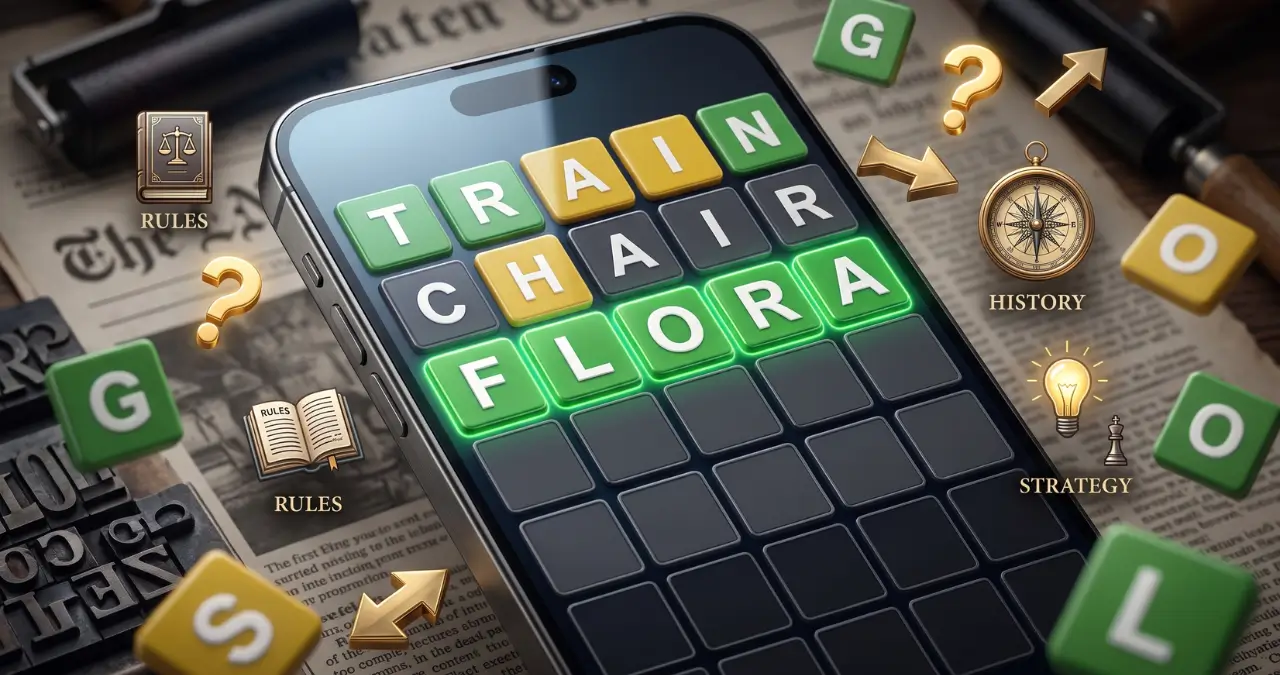
Wordle NYT gives you six attempts to guess a five-letter word, with color-coded tiles telling you how close each guess is. A green tile means the letter is correct and in the right spot; yellow means it’s in the word but the wrong position; gray means the letter isn’t in the word at all.
Every player worldwide gets the exact same word each day, and the puzzle resets at midnight in your local time zone. There’s no timer and no penalty for taking a break mid-puzzle — you can start a guess in the morning and finish it that night, as long as it’s before the date changes.
The game also offers a Hard Mode, which forces you to reuse any correct letters (green or yellow) in your next guess instead of testing entirely new words. It’s optional, toggled in settings, and doesn’t affect your ability to share results — it’s purely a self-imposed difficulty setting for players who want less room to explore the board freely.
The History Behind Wordle NYT
Wordle wasn’t originally an NYT product at all. Software engineer Josh Wardle built it as a private project for himself and his partner, with the game’s own code dating its first version to June 2021, before Wardle released it publicly in October 2021 under the name Wordle — a play on his own surname.
The New York Times Company acquired Wordle in January 2022 for what the Times described as a low seven-figure sum, shortly after the game exploded across social media thanks to its shareable, spoiler-free emoji grid. That acquisition is the reason searches for “Wordle NYT” outnumber plain “Wordle” today — the game has been fully NYT property for over four years now, integrated first into the Crossword app and later into the standalone NYT Games app and website.
What Changed When the NYT Took Over
The most significant change came in November 2022, when the Times assigned Tracy Bennett, previously an editor on its crossword team, as Wordle’s first dedicated word editor. Her job was refining which words could appear as daily answers, moving away from the original creator’s informal list toward more careful curation.
Alongside that, the Times announced specific rule changes: answers would no longer be simple plurals formed by adding “S” or “ES” to a shorter word — so FOXES or SPOTS would never be an answer, though GEESE or FUNGI still could be. Offensive and obscure words were also trimmed from the potential answer list, while the separate, much larger dictionary of acceptable guesses stayed largely uncurated, meaning you can still type more unusual words as guesses even if they’d never appear as a solution.
None of this changed the core mechanics. Six guesses, five letters, one puzzle a day — that part of Wordle NYT has stayed untouched since day one.
WordleBot: Wordle NYT’s Built-In Analysis Tool
WordleBot is the New York Times’ own scoring tool that reviews your completed Wordle NYT puzzle and rates your performance on skill and luck, each on a 0–99 scale, compared against how other players solved the same word. It launched in 2022, not long after the acquisition, and has become one of the more genuinely useful features the Times added to the game.
After you finish a puzzle, WordleBot walks through each of your guesses, shows how many possible answers remained at each step, and highlights where a different word choice would have narrowed things down faster. It also tracks a daily average — for puzzle #1,889 on August 21, 2026, for example, WordleBot reported an average solve of 3.1 guesses across both Easy and Hard mode, a genuinely easy day by the game’s historical standards.
One detail worth knowing: WordleBot’s difficulty average and the New York Times’ own internal difficulty rating aren’t always the same number. The internal rating comes from a small panel of paid human testers who solve the puzzle in advance, while WordleBot’s number comes from aggregating actual results across everyone who played that day — so on any given day, you might see two slightly different “average guesses” figures depending on which source you’re reading.
Wordle NYT Archive and Subscription Access
The Wordle NYT archive gives subscribers access to more than 1,000 past puzzles, dating back to the game’s earliest days, so you can catch up on ones you missed or just replay favorites. NYT Games rolled the archive out in May 2024, and it’s grown alongside the daily puzzle count ever since — by mid-2026 it covers well over 1,500 solved puzzles.
Free players can still play the current day’s puzzle at no cost, which hasn’t changed since the Times took over. But the archive, along with WordleBot’s detailed guess-by-guess breakdown beyond the basic score, sits behind a Games or All Access subscription. Pricing has moved around since launch, so check nytimes.com/games directly for the current rate rather than trusting an old screenshot — subscription costs are exactly the kind of detail that goes stale fast.
In late 2025, the Times also added a Create Your Own Puzzle feature to Wordle NYT, letting subscribers build a custom five-letter puzzle and share it through a unique link that non-subscribers can open and play. It’s a smaller addition compared to the archive or WordleBot, but it’s the first time Wordle NYT has let players generate content instead of just consuming it.
Strategy Tips for Wordle NYT
The single most effective habit in Wordle NYT is choosing a strong opening word packed with common, non-repeating letters and at least two vowels. WordleBot’s own data has repeatedly favored words like SLATE, CRANE, and TRACE as strong starters, precisely because they surface high-frequency letters early without wasting a guess on repeats.
From there, your second guess matters almost as much as your first. A good second word should avoid reusing letters you already know are gray, while still testing fresh common letters — this is where a lot of casual players lose efficiency, sticking with a word that “feels close” instead of one that actually eliminates the most possibilities.
Hard Mode changes this calculus. Because you’re locked into using confirmed letters, your strategic freedom narrows fast, and the skill shifts from “which letters should I test” to “which valid word fits everything I already know.” It’s a genuinely different mental exercise, not just a harder version of the same game — which is part of why WordleBot tracks Easy and Hard mode averages separately rather than combining them.
Wordle NYT Compared to Other NYT Word Games
Wordle NYT is a letter-position deduction game, while its NYT Games siblings, Connections and Spelling Bee, test entirely different skills — Connections asks you to group 16 words into four hidden categories, and Spelling Bee challenges you to build as many valid words as possible from seven given letters. If you enjoy Wordle NYT’s daily-puzzle rhythm, both are worth trying, but they won’t scratch quite the same itch, since neither uses Wordle’s color-feedback deduction mechanic.
This distinction matters more than it sounds, because a lot of general “NYT games” roundup content lumps all three together as interchangeable word puzzles. They’re not. Wordle rewards narrowing a search space through elimination; Spelling Bee rewards vocabulary breadth; Connections rewards pattern recognition across categories. Someone who’s great at one isn’t automatically great at the others, and treating them as one skill set is a common misconception worth correcting.
Is Wordle NYT Free?
Yes, the core daily Wordle NYT puzzle remains completely free to play, with no ads and no account required, exactly as it was before the New York Times acquired it in 2022. You can play directly at nytimes.com/games/wordle or through the NYT Games app on iOS and Android.
Creating a free account does add value even without a subscription: it lets you track your streak, save your stats, and sync progress across devices. What sits behind a paywall is the extra layer — the full archive of past puzzles, WordleBot’s deeper breakdown features, and access to the Times’ other daily games like Connections, Spelling Bee, and the Crossword.
Frequently Asked Questions
What is Wordle NYT?
Wordle NYT is the daily word-guessing game owned by The New York Times, where players get six attempts to identify a hidden five-letter word using color-coded feedback on each guess.
Is Wordle NYT free to play?
Yes. The daily puzzle is free with no account required, though creating a free NYT account lets you save your streak and stats across devices.
Who created Wordle before the NYT owned it?
Software engineer Josh Wardle created Wordle as a private project in 2021 before releasing it publicly that October; The New York Times acquired it in January 2022.
Does Wordle NYT reset at midnight?
Yes, a new puzzle becomes available at midnight in your local time zone, and there’s no time limit for completing the current day’s word before then.
What is WordleBot in Wordle NYT?
WordleBot is the Times’ built-in tool that scores your completed puzzle on skill and luck, shows how many possible answers remained after each guess, and compares your result to the daily average.
Can I play old Wordle NYT puzzles?
Yes, through the Wordle Archive, which offers access to more than 1,000 past puzzles, though this feature requires an NYT Games or All Access subscription.
Are Wordle NYT answers ever plurals?
The Times has said answers will never be a simple plural made by adding “S” or “ES” to a shorter word, though some plurals with irregular spellings, like GEESE, remain valid answers.
What’s the difference between Wordle NYT’s Easy and Hard mode?
Hard Mode requires you to reuse any letters you’ve already confirmed as correct in your next guess, while Easy Mode lets you test any valid word regardless of prior clues.
Is Wordle NYT the same as Wordle before the acquisition?
The core rules are unchanged, but word selection is now curated by a dedicated NYT editor, and features like WordleBot, the puzzle archive, and Create Your Own Puzzle didn’t exist before the Times took over.
How is Wordle NYT different from Connections and Spelling Bee?
Wordle NYT tests letter-position deduction through elimination, while Connections tests pattern recognition by grouping words into categories, and Spelling Bee tests vocabulary by building words from a fixed set of letters — they’re related NYT games but test different skills.