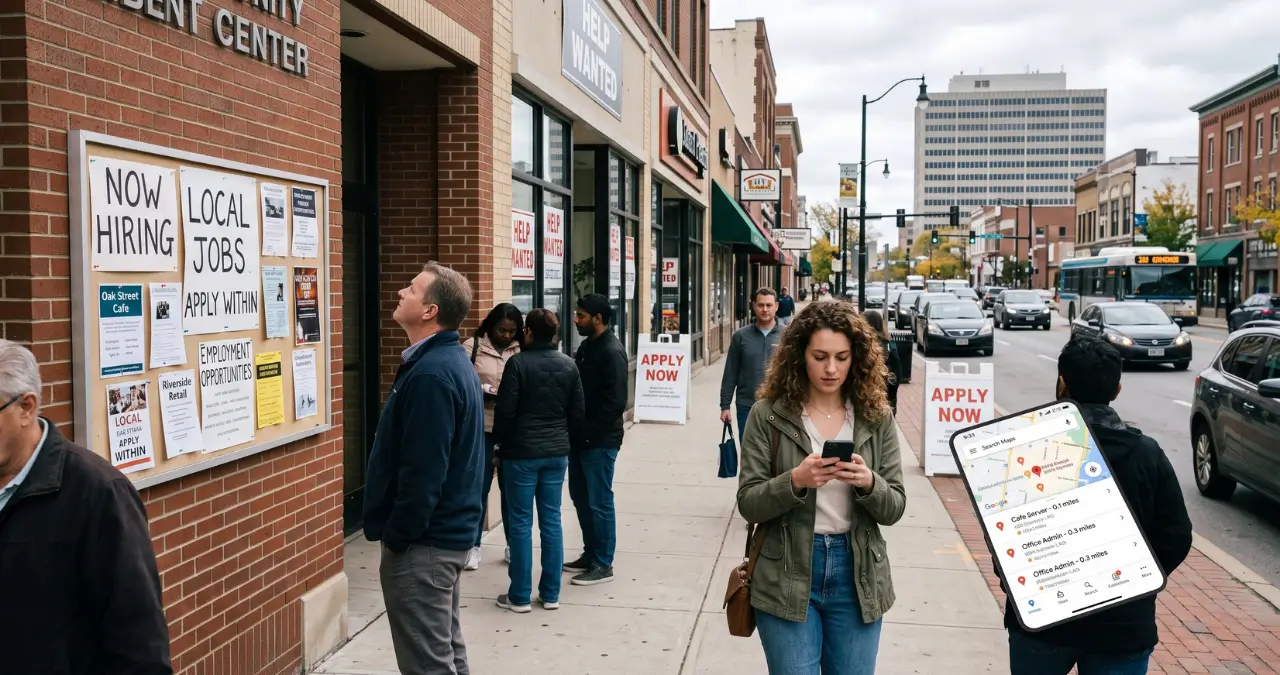







Digital marketing jobs cover a wide range of roles focused on promoting products and brands through online channels like search, social media, email, and paid advertising. The field remains a genuinely strong career path in 2026, though hiring has gotten more selective than it was a few years ago. Employers now favor specialists who can prove measurable results over generalists with a broad but shallow skill set.
This shift matters if you’re actually job-hunting right now. Understanding which digital marketing jobs are growing, which are shrinking, and what pay actually looks like will save you time compared to applying broadly and hoping something sticks.
What Are Digital Marketing Jobs?
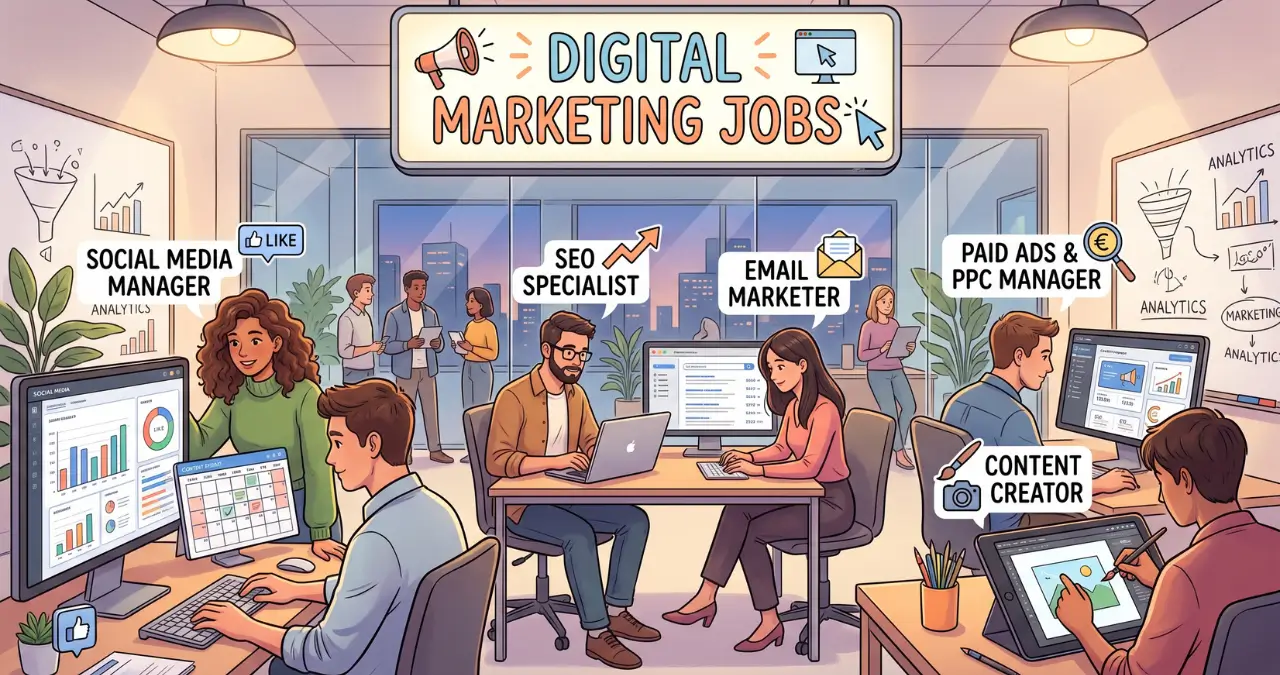
Digital marketing jobs are roles focused on reaching and converting customers through online channels rather than traditional media like print, TV, or radio. Common examples include SEO specialist, paid media manager, email marketer, social media manager, content strategist, and marketing analyst.
Most of these roles sit under a broader marketing or growth team and report to a marketing manager or director. The specific responsibilities vary a lot by company size. At a startup, one person might run SEO, email, and social media together. At a larger company, each of those functions is usually its own dedicated role with a narrower scope.
Are Digital Marketing Jobs in Demand in 2026?
Yes, digital marketing jobs remain in demand in 2026, though growth has slowed compared to the hiring boom of the early 2020s. The U.S. Bureau of Labor Statistics projects employment for advertising, promotions, and marketing managers to grow about 6.6% through 2034, faster than the average for all occupations, while market research analyst roles are projected to grow even faster at roughly 6.7%.
That said, staffing firm Addison Group has noted that overall digital marketing hiring in 2026 sits about 25% below pre-pandemic levels, even as demand for specific skill sets stays strong. In other words, there are fewer open roles overall than there were several years ago, but the roles that do open up are more selective about the specific skills they require.
Demand is strongest for a fairly specific list: SEO specialists, digital marketing managers, market research analysts, and professionals with AI and automation experience. Roles centered on marketing analytics and attribution are also holding up well, since companies increasingly want to know exactly which campaigns are driving revenue rather than just traffic.
Types of Digital Marketing Jobs and What They Pay
Digital marketing jobs span a wide range, from entry-level coordinator roles to senior director and VP positions, with pay scaling accordingly. Titles and responsibilities don’t always match perfectly across companies, so it helps to think in terms of experience tiers rather than job titles alone.
Entry-Level Digital Marketing Jobs
Entry-level digital marketing jobs typically include titles like digital marketing coordinator, SEO executive, social media coordinator, or marketing analyst trainee. These roles focus on execution: running campaigns someone else designed, managing content calendars, and getting comfortable with core tools like Google Analytics and a CMS.
Research.com reports entry-level digital marketing professionals earning around $52,110 annually on average, while Robert Half’s 2026 Salary Guide lists digital marketing specialist pay in a broader range of roughly $58,500 to $82,500 depending on experience and location.
Mid-Level and Senior Digital Marketing Jobs
Mid-level and senior digital marketing jobs include digital marketing manager, SEO manager, paid media director, and content strategy lead. These roles typically own a channel or team rather than just executing tasks, and pay reflects that added responsibility.
Glassdoor puts the median total pay for a digital marketing manager at around $129,000 as of mid-2026, while BLS data shows marketing managers overall earning a median wage of $166,790 in May 2025, with the highest concentrations of these jobs in states like New York, Massachusetts, and California. The gap between those two figures reflects the difference between a “digital marketing manager” title specifically and the broader “marketing manager” category BLS tracks.

How Much Do Digital Marketing Jobs Pay?
Pay for digital marketing jobs varies significantly by role, experience, and location, generally ranging from around $50,000 for entry-level positions to well over $150,000 for senior strategy and leadership roles. Different salary sources report somewhat different numbers because they define roles and sample populations differently, so treat any single figure as a data point rather than a guarantee.
A few consistent patterns show up across multiple sources. Marketing managers overall earned a mean annual wage of $177,770 in May 2025, according to BLS data. In-house digital marketing roles tend to pay more than agency roles, with Neil Patel’s research showing in-house professionals averaging around $95,094 compared to lower agency averages. Finance, technology, and manufacturing consistently rank among the highest-paying industries for digital marketing talent.
One genuinely useful data point for negotiating: professionals who can demonstrate hands-on experience with AI tools, Python, or SQL reportedly earn 15% to 30% more than peers without those skills, based on data from both Addison Group and Digital Applied’s 2026 salary guide. That’s a meaningfully large premium, and it’s becoming one of the clearest ways to differentiate yourself in a tighter hiring market.
Skills That Get You Hired for Digital Marketing Jobs
The skills that matter most for digital marketing jobs in 2026 are data analytics, AI tool proficiency, SEO, paid advertising management, and marketing automation. A 2026 Robert Half survey of marketing and creative leaders found employers willing to pay more for digital marketing strategy skills specifically (cited by 44% of leaders), followed by AI and machine learning (37%), marketing automation (33%), and marketing research and analytics (32%).
Analytics has become close to a baseline requirement rather than a specialization. Roughly 19% of all digital marketing job postings in 2025 specifically required analytics skills, according to Robert Half’s research, a signal that even non-analytics roles increasingly expect comfort with data.
AI fluency is the fastest-moving requirement. Job postings for the “AI Marketing Manager” title grew roughly eightfold between 2024 and early 2026, according to Digital Applied’s salary research, jumping from under 500 U.S. postings to more than 4,200 in that span. That’s a genuinely fast shift for a job title to go from niche to mainstream, and it reflects how quickly companies have moved to build AI capability directly into marketing teams rather than treating it as a separate function.
Best Certifications for Digital Marketing Jobs
The most commonly requested certifications for digital marketing jobs include Google Ads Certification, Google Data Analytics Certification, HubSpot’s Inbound Marketing Certification, and, for more senior roles, Project Management Professional (PMP) or Salesforce CRM certification. These show up repeatedly across employer surveys as credentials hiring managers actually look for.
Certifications alone won’t land you a role without practical experience to back them up, but they matter more in this field than in many others. That’s because digital marketing tools change often enough that a certification signals you’ve kept your skills current, not just that you studied a textbook years ago.
If you’re choosing where to start, Google Ads and Google Analytics certifications tend to have the broadest applicability, since nearly every digital marketing role touches paid search or performance measurement in some way.
Remote and Hybrid Digital Marketing Jobs
Digital marketing jobs are now predominantly hybrid or remote-friendly, with one 2025 recruitment report finding 88% of employers offering hybrid arrangements and about 12% of new postings being fully remote. That’s a meaningful shift from a fully in-office norm, and it’s one of the more durable changes to come out of the pandemic-era work shift.
This flexibility cuts both ways for job seekers. It widens the pool of roles you can apply to regardless of where you live, but it also means you’re competing with a much larger applicant pool for the same remote listings. Teams that manage this well tend to set clear outcome-based expectations rather than tracking hours, since marketing work is easier to evaluate by results than by time logged.
How to Find and Land Digital Marketing Jobs
The most effective way to land digital marketing jobs in 2026 is pairing a focused specialization with a portfolio that shows measurable results, rather than applying broadly with a generalist resume. Employers are explicitly hiring fewer generalists and more specialists who can point to specific outcomes they’ve driven.
A practical approach that works well for candidates without much formal experience: run a small campaign for a local business, nonprofit, or even a personal project, and document the actual results, traffic growth, conversion rate, cost per lead, whatever’s measurable. That kind of concrete example tends to outperform a bullet-point list of responsibilities on a resume, because it shows you understand outcomes, not just tasks.
Freelance and contract work has also become a more common entry point into full-time digital marketing jobs. More than half of marketing leaders report hiring more freelancers than they used to, according to Neil Patel’s research, which means a strong freelance track record can genuinely open doors to permanent roles rather than being a dead end.
Digital Marketing Jobs vs. Traditional Marketing Jobs
Digital marketing jobs focus specifically on online channels and are typically measured with real-time, granular data, while traditional marketing jobs cover offline channels like print, TV, radio, and events, where results are harder to measure precisely. The core difference isn’t really the creative work involved, it’s how directly you can trace a campaign to a specific outcome.
In practice, most marketing teams now blend the two rather than treating them as separate departments. A brand campaign might run across TV and social media simultaneously, with the digital portion generating clear performance data that helps justify or adjust the offline spend. If you’re choosing between the two paths, digital marketing jobs generally offer clearer, faster feedback loops and more measurable career progression, which is part of why the field has grown as consistently as it has.
Frequently Asked Questions
What are the highest-paying digital marketing jobs?
Senior roles like marketing director, VP of marketing, and product marketing manager tend to pay the most, with BLS data showing marketing managers earning a median wage of $166,790 as of May 2025, and top-paying metro areas like San Jose reaching well above $250,000 for this role.
Are digital marketing jobs still in demand in 2026?
Yes, though hiring has become more selective. Demand remains especially strong for SEO specialists, marketing analysts, and professionals with AI tool experience, even as overall postings sit below pre-pandemic peaks.
Do you need a degree for digital marketing jobs?
Most roles list a bachelor’s degree as preferred or required, but many employers increasingly prioritize a demonstrable portfolio and hands-on skills over formal credentials alone.
What skills are most in demand for digital marketing jobs right now?
Data analytics, AI tool proficiency, SEO, paid advertising management, and marketing automation consistently rank as the most sought-after skills across 2026 employer surveys.
How much do entry-level digital marketing jobs pay?
Entry-level roles generally start around $50,000 to $58,000 annually in the U.S., though this varies by location, industry, and specific job title.
Are digital marketing jobs remote-friendly?
Yes. A large majority of employers now offer hybrid arrangements, and a meaningful share of new digital marketing job postings are fully remote.
What certifications help with getting digital marketing jobs?
Google Ads Certification, Google Data Analytics Certification, and HubSpot’s Inbound Marketing Certification are among the most commonly requested credentials in job postings and employer surveys.
Is AI replacing digital marketing jobs?
Not broadly, but it is reshaping them. AI is automating routine tasks like basic ad optimization and reporting, while increasing demand for professionals who can strategize, interpret data, and manage AI tools effectively.
Which industries hire the most for digital marketing jobs?
Technology, financial services, and manufacturing consistently rank among the top-paying and highest-hiring industries for digital marketing talent, according to multiple 2026 salary surveys.
What’s the difference between a digital marketing specialist and a digital marketing manager?
A specialist typically executes campaigns within a specific channel, like SEO or paid media, while a manager oversees strategy, budget, and often a team across multiple channels, with pay and responsibility scaling accordingly.