









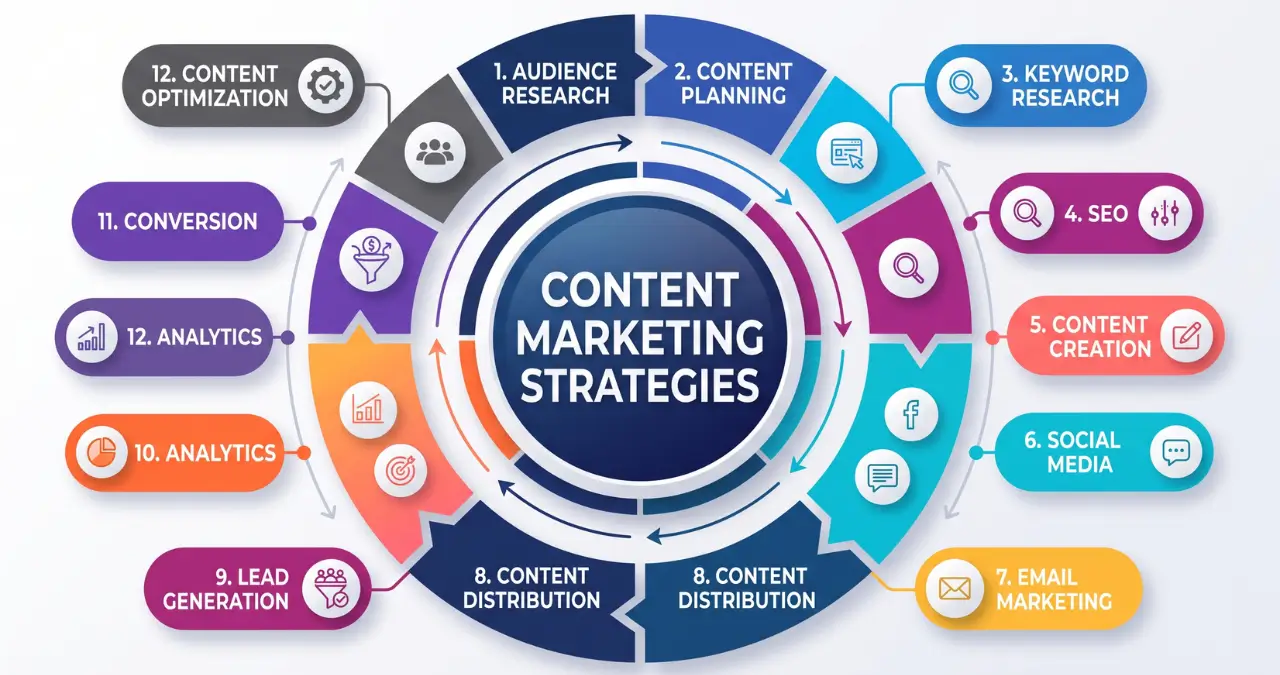
Content marketing strategies are documented plans that define who you’re creating content for, what problems that content solves, and how it moves people toward a business outcome. A real strategy is a written plan tied to specific goals, not just a content calendar or a list of blog topics — and that distinction matters more than most guides admit.
According to the Content Marketing Institute’s 2026 B2B research, based on a survey of over 1,000 marketers, organizations with a documented strategy consistently outperform those without one, yet plenty of teams still operate without writing theirs down. This guide walks through what a working strategy actually includes, how to build one, and how to adapt it for a search landscape that now includes AI Overviews and chat-based search tools alongside traditional Google results.
What Are Content Marketing Strategies, Exactly?
A content marketing strategy is a documented plan connecting your audience’s needs to your business goals through specific content decisions — what you’ll create, for whom, through which channels, and how you’ll measure whether it worked. It’s different from a content calendar, which is just a schedule, and different from a style guide, which just governs tone and formatting.
The distinction isn’t academic. A calendar without a strategy behind it tends to produce content that’s consistent in timing but scattered in purpose — a blog post here, a video there, none of it building toward anything measurable. A real strategy forces you to answer why each piece exists before you write it.
Core Elements of Effective Content Marketing Strategies
Every functioning content marketing strategy includes four things: defined audience personas, clear business goals, a content mix mapped to the buyer journey, and a measurement plan tied back to those goals. Miss any one of these, and the strategy tends to collapse into content production for its own sake.
Audience personas need to go beyond basic demographics — they should capture the specific questions and objections your buyers have at each stage of deciding whether to work with you. Business goals should be concrete: more qualified leads, shorter sales cycles, higher retention, not vague aims like “increase awareness.” The content mix maps formats and topics to where someone sits in that journey, from early research to final decision. And the measurement plan defines upfront which numbers will tell you the strategy is working, rather than deciding that after the fact.
Audience Research and Buyer Personas
Audience research means finding out what your actual customers search for, ask, and struggle with, using real data rather than assumptions about who they are. This can come from sales call transcripts, support tickets, keyword research, or direct customer interviews — the point is grounding your content decisions in evidence instead of guesswork.
A genuinely useful buyer persona documents the specific language a prospect uses to describe their problem, not just their job title and company size. If your sales team keeps hearing the same three objections on calls, those objections belong in your content strategy as topics to address directly, ideally before a prospect ever talks to sales.
Setting Measurable Goals
Measurable content marketing goals connect directly to business outcomes — pipeline generated, cost per lead, retention rate — rather than vanity metrics like raw traffic or social shares. Traffic and shares aren’t meaningless, but they’re proxy metrics, and treating them as the finish line is one of the most common ways content strategies drift from actual business impact.
A useful test: if a metric went up but revenue, leads, or retention didn’t move, would you still call the content successful? If the honest answer is no, that metric shouldn’t be the primary goal in your strategy document.
How to Build a Content Marketing Strategy Step by Step
Building a content marketing strategy starts with defining a specific business goal, then works backward through audience research, topic and format planning, distribution channels, and a measurement framework. Skipping straight to “what should we write about” without the earlier steps is the most common reason strategies fail to produce results.
- Define the business goal first. Decide what you’re actually trying to move — leads, retention, brand search volume — before deciding on topics.
- Research your audience’s real questions. Pull from sales calls, support tickets, and keyword data instead of guessing.
- Map content to the buyer journey. Early-stage content should educate; late-stage content should address specific objections and comparisons.
- Choose formats deliberately. Not every topic needs to be a blog post — some are better suited to video, a tool, or a short-form social explanation.
- Plan distribution alongside creation. Deciding how a piece will reach its audience is part of the strategy, not an afterthought once it’s published.
- Set your measurement framework before launch. Know which numbers define success before you publish, not after.
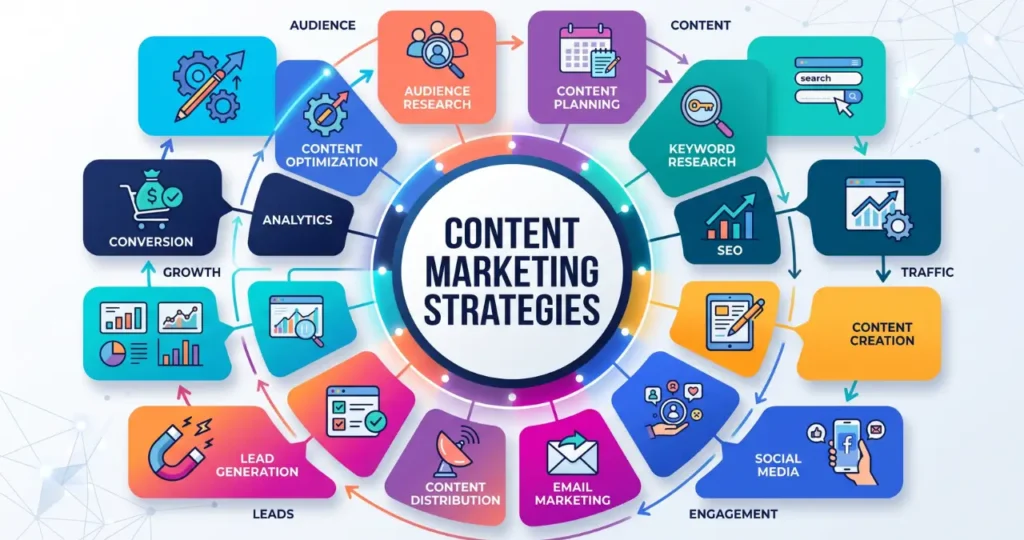
Content Marketing Strategies for AI Search and AI Overviews
Content marketing strategies now need to account for AI-generated search results, not just traditional blue-link rankings, because a meaningful share of searches now end without a click to any website at all. Multiple 2026 industry reports point to roughly half of searches resolving through AI Overviews or zero-click results rather than a traditional click-through, which changes what “ranking well” actually means for a piece of content.
This is the part most generic content marketing guides still treat as an afterthought, and it’s worth being direct about it: writing purely for a human reader scrolling a results page is no longer the whole job. AI systems like Google’s AI Overviews, ChatGPT Search, and Perplexity tend to pull from content that states facts clearly and self-sufficiently — a section that can be lifted out and understood without the surrounding page. Content marketing strategies built around answer-first structure, where each section opens with a direct, standalone answer before expanding, tend to get cited by these systems more consistently than content built around long narrative buildup.
Practically, this means restructuring how content gets planned, not just how it gets written. A content brief in 2026 should specify the exact question a section answers in its first sentences, the same way a featured-snippet-focused brief did a few years ago — except now the target audience for that clarity includes AI systems as well as human skimmers.
Content Formats to Include in Your Strategy
A strong content marketing strategy mixes formats deliberately rather than defaulting to blog posts for everything, since different formats serve different points in the buyer journey and different audience preferences. Blogs remain a core format for search-driven education, but video, original research, case studies, and interactive tools each pull weight blogs can’t.
Original research and proprietary data deserve particular attention here, since they’re one of the few content types that’s genuinely hard for competitors — or AI tools — to replicate. Industry surveys from 2026 consistently show that marketers publishing original research report stronger organic performance and higher conversion rates than those relying purely on synthesized or aggregated content, which tracks with a simple logic: a data point only your organization has is inherently more citable than a rehash of publicly available information.
Case studies and customer stories matter for a related reason — they carry a kind of trust signal that generic advice content can’t replicate, since they document a specific, verifiable outcome rather than a general claim.
Measuring Content Marketing Strategy Success
Measuring a content marketing strategy means tracking a small set of metrics tied directly to the business goal defined at the start, checked on a consistent cadence rather than in an annual review. The right metrics differ by goal: a lead-generation strategy tracks conversion rate and cost per lead; a retention-focused strategy tracks engagement from existing customers rather than new visitor volume.
Attribution is the hardest part of this in practice, since most buyers interact with several pieces of content before converting, and giving 100% credit to the last touchpoint before a form fill overstates that one page’s actual contribution. Multi-touch attribution models, even simple ones, tend to give a more honest picture of which content is actually influencing decisions along the way, not just which content happens to sit at the end of the journey.
Common Mistakes That Undermine Content Marketing Strategies
The most common mistake in content marketing strategies is treating content volume as a proxy for strategy — publishing more without a clear connection between each piece and a specific business outcome. AI tools have made this mistake easier to make at scale, since generating more content is no longer the bottleneck it used to be, but volume without direction just produces more content that doesn’t move any metric that matters.
A second recurring mistake is skipping distribution planning, assuming good content will find its audience through search alone. Even genuinely strong content usually needs a deliberate push through email, social, or partner channels to reach the people it was written for, especially in its first weeks when it has no existing search visibility to lean on.
A third mistake worth naming: setting the measurement framework after content is already published, rather than before. Retrofitting metrics onto existing content almost always produces a flattering-but-useless picture, since it’s tempting to highlight whichever numbers happened to look good rather than the ones that were actually the point.
B2B vs. B2C Content Marketing Strategies
B2B and B2C content marketing strategies differ mainly in sales cycle length and decision-making structure, which changes what content needs to accomplish at each stage. B2B buying decisions typically involve multiple stakeholders and a longer research phase, so B2B content marketing strategies tend to lean on in-depth guides, comparison content, and case studies that help a buying committee build internal consensus.
B2C content marketing strategies, by contrast, often work with shorter decision windows and a single decision-maker, which shifts the emphasis toward emotional resonance, speed, and format variety — short video and social content carry more relative weight than they typically do in B2B. Neither approach is inherently better; the right mix depends entirely on how your specific buyers actually make decisions, which is exactly why the audience research step earlier in this guide isn’t optional.
Frequently Asked Questions
What are content marketing strategies?
Content marketing strategies are documented plans connecting audience needs to business goals through specific decisions about what content to create, for whom, through which channels, and how success will be measured.
How is a content marketing strategy different from a content calendar?
A content calendar is a publishing schedule, while a content marketing strategy is the underlying plan that determines why each piece of content exists and what business outcome it’s meant to drive.
What’s the first step in building a content marketing strategy?
Defining a specific, measurable business goal comes first, since audience research, topic planning, and format decisions should all work backward from that goal rather than being decided independently.
Do content marketing strategies need to account for AI Overviews and AI search?
Yes. With a substantial share of searches now resolving through AI-generated summaries rather than traditional clicks, content marketing strategies increasingly need answer-first, self-contained sections that AI systems can cite directly.
What metrics matter most in a content marketing strategy? The metrics that matter are the ones tied directly to your stated business goal — leads, pipeline, retention, or cost per acquisition — rather than proxy metrics like raw traffic or social shares.
Is original research worth including in a content marketing strategy?
Yes. Original research and proprietary data tend to outperform aggregated content because competitors and AI tools can’t replicate a data point only your organization has collected.
How often should a content marketing strategy be reviewed?
Most organizations benefit from reviewing strategy performance quarterly, checking whether the chosen metrics are trending toward the original business goal rather than waiting for an annual review.
What’s the biggest mistake in content marketing strategies?
Treating content volume as a substitute for strategy — publishing frequently without a clear line between each piece and a specific business outcome — is the most common failure pattern.
Do B2B and B2C companies need different content marketing strategies?
Yes, generally. B2B strategies typically lean on in-depth, consensus-building content for longer sales cycles with multiple stakeholders, while B2C strategies often prioritize speed, emotional resonance, and format variety for shorter, single-decision-maker purchases.
How does distribution fit into a content marketing strategy?
Distribution should be planned alongside content creation, not treated as an afterthought, since even strong content typically needs a deliberate push through email, social, or partner channels to reach its intended audience.