









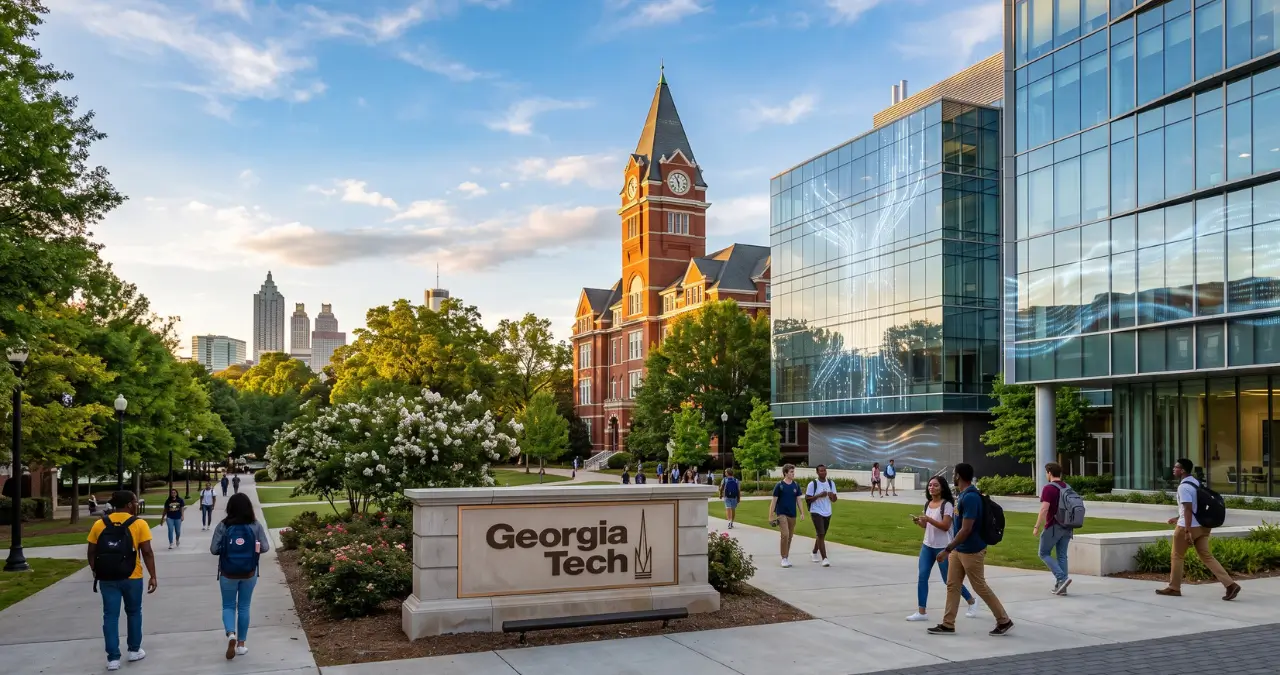
Georgia Tech is one of the leading public research universities in the United States, particularly known for engineering, computing, technology, and innovation. Officially called the Georgia Institute of Technology, Georgia Tech is based in Atlanta and combines rigorous academics with research, entrepreneurship, internships, and career-focused learning.
For students comparing universities, the biggest question is not simply whether Georgia Tech is prestigious. It is whether its academic strengths, admissions standards, costs, location, and hands-on opportunities fit their goals.
What Is Georgia Tech Known For?
Georgia Tech is best known for engineering, computer science, technology, research, and innovation. Its undergraduate engineering program is ranked No. 3 nationally in the 2026 U.S. News rankings, while every undergraduate engineering discipline ranks among the top six.
The university offers programs across business, computing, design, engineering, liberal arts, and sciences. Students can also combine interests across disciplines, which is particularly useful for fields such as artificial intelligence, robotics, cybersecurity, data science, and technology management.
Georgia Tech’s reputation is especially strong among students who want careers involving technical problem-solving. Its academic environment emphasizes projects, research, practical application, and interdisciplinary work rather than relying entirely on traditional classroom learning.
The university is also an R1 research institution. Its research ecosystem includes seven colleges, interdisciplinary research institutes, the Georgia Tech Research Institute, hundreds of laboratories and centers, and partnerships with government and industry.
That combination makes Georgia Tech particularly attractive for students interested in technology-driven industries.
Georgia Tech Rankings and Academic Reputation
Georgia Tech ranks highly across engineering, computing, business, research, and innovation. However, students should look beyond a single overall ranking because the university’s strongest areas are concentrated in technical and quantitative disciplines.
For the 2026 U.S. News undergraduate rankings, Georgia Tech is No. 9 among public universities and No. 32 among national universities. It is also No. 3 for undergraduate engineering and No. 5 for undergraduate computer science.
Several individual programs stand out:
- Biomedical engineering: No. 1
- Environmental engineering: No. 1
- Industrial engineering: No. 1
- Aerospace engineering: No. 2
- Chemical engineering: No. 2
- Civil engineering: No. 2
- Electrical engineering: No. 3
- Mechanical engineering: No. 4
- Computer engineering: No. 6
- Computer science: No. 5
Georgia Tech also performs strongly at the graduate level. In the 2027 U.S. News graduate rankings, published in 2026, its graduate engineering school ranked No. 4 nationally, while several engineering specialties placed in the top five.
The practical takeaway is simple: Georgia Tech is particularly compelling if your intended field is engineering, computing, technology, analytics, or another STEM-heavy discipline.
Georgia Tech Programs and Majors
Georgia Tech offers 39 undergraduate majors across six colleges, giving students substantial choice while maintaining a strong technology and science focus.
Popular academic areas include computer science, aerospace engineering, mechanical engineering, electrical engineering, biomedical engineering, industrial engineering, business, architecture and design, mathematics, physics, and economics.
Computer Science and Computing
Georgia Tech’s College of Computing is one of its most recognized academic areas. Its undergraduate computer science curriculum uses a Threads approach, allowing students to develop depth in areas aligned with their interests.
The university’s 2026 undergraduate rankings place it particularly high in several computing categories, including mobile and web applications, cybersecurity, software engineering, artificial intelligence, and data analytics.
This makes Georgia Tech worth considering for students interested in software development, AI, cybersecurity, data science, and related technology careers.
Engineering
Engineering remains the university’s signature strength. Georgia Tech has 11 undergraduate engineering programs that rank among the nation’s highest, covering areas from aerospace and mechanical engineering to biomedical, civil, electrical, chemical, and industrial engineering.
Students who want an engineering degree with substantial access to research and industry opportunities may find the environment especially valuable.
Georgia Tech Admissions: How Hard Is It to Get In?
Georgia Tech is a selective university, and admission is competitive. The university uses a holistic first-year application review process, meaning applicants are evaluated using more than a single academic number.
For context, Georgia Tech reported 13,100 applications from Georgia residents for the 2026 first-year admission cycle, with 3,621 students admitted, producing a 28% admit rate for that applicant group. This figure applies specifically to Georgia applicants and should not be treated as the overall admission rate for all applicants.
Applicants should therefore avoid judging their chances using one acceptance-rate figure.
Academic preparation matters greatly, especially for students applying to demanding STEM programs. Strong performance in challenging mathematics, science, and relevant coursework can help demonstrate readiness.
Georgia Tech exclusively uses the Common Application for first-year applicants. Prospective students should also check the university’s current deadlines and program-specific requirements before applying because requirements and deadlines can change.
Georgia Tech Tuition and Cost
Georgia Tech’s cost depends heavily on a student’s tuition classification. The university identifies students as in-state, out-of-state, or out-of-country, and that classification determines the applicable tuition rate.
For the 2027 fiscal year, the University System of Georgia approved a 1% in-state tuition increase and a 3% increase for out-of-state and out-of-country students.
That distinction matters for international students. A student applying from outside the United States should not assume that Georgia resident tuition applies simply because the university is a public institution.
Total cost also includes expenses beyond tuition, such as housing, food, books, transportation, fees, and personal expenses. Georgia Tech directs prospective students to its official cost-of-attendance and financial-aid resources for current estimates.
The best approach is to calculate the full annual cost rather than comparing tuition alone.

Is Georgia Tech Good for International Students?
Georgia Tech has a substantial international student population, particularly at the graduate level. Fall 2025 data show 1,589 international undergraduate students and 11,851 international graduate students.
For international applicants, the application process can involve additional academic-document and transcript considerations. Georgia Tech provides specific resources explaining how international academic backgrounds are reviewed.
The university’s Atlanta location is another advantage. Atlanta is a major U.S. business and technology center, giving students access to companies, internships, research organizations, and professional networks.
However, international applicants should evaluate the total cost carefully. Tuition classification, housing, insurance, travel, visa-related expenses, and available financial aid can make the financial calculation substantially different from that of a domestic student.
Georgia Tech Co-ops, Internships, and Career Opportunities
Georgia Tech places unusually strong emphasis on practical work experience. Its undergraduate co-op program allows students to alternate academic semesters with full-time paid employment related to their major.
The co-op program is optional and typically involves at least three work terms. Students can gain a year or more of relevant professional experience while completing their degree, and the experience is documented on their academic transcript.
This is an important distinction when comparing Georgia Tech with universities that focus more heavily on conventional classroom education.
Internships are also an important part of the Georgia Tech experience. The university ranks No. 3 for co-op and internship programs in its 2026 U.S. News undergraduate rankings.
For students choosing between a university with strong theory and one that combines theory with structured workplace experience, this can be a meaningful advantage.
Georgia Tech Research and Innovation
Georgia Tech is deeply involved in research spanning science, engineering, computing, technology, and public-sector applications. Its research community includes faculty, students, laboratories, interdisciplinary institutes, and the Georgia Tech Research Institute.
The Georgia Tech Research Institute conducts applied research for government and industry, creating opportunities connected to areas such as advanced technology, engineering, cybersecurity, and national security.
Students can also participate in undergraduate research. Georgia Tech provides pathways for undergraduates to work with faculty and engage in research activities alongside their studies.
For students considering graduate school, research careers, or technology development, this ecosystem can be just as important as classroom rankings.
What Is Campus Life Like at Georgia Tech?
Georgia Tech’s campus sits on a 426-acre site in the heart of Atlanta. Although the university has a strong technical reputation, student life extends beyond laboratories and classrooms.
The university has more than 500 student organizations, campus traditions, Division I athletics, recreational programs, and numerous competitive and intramural sports opportunities.
The Atlanta setting also changes the college experience. Students are not isolated from a major metropolitan economy; the campus is surrounded by businesses, cultural attractions, transportation connections, and professional opportunities.
For someone who wants a traditional college environment combined with access to a major technology and business market, that location can be a significant advantage.
Is Georgia Tech Worth It?
Georgia Tech can be an excellent choice for students who want a rigorous education in engineering, computing, technology, business analytics, or related fields and who are willing to handle a demanding academic environment.
Its strongest differentiator is the combination of highly ranked technical programs, research opportunities, Atlanta’s industry ecosystem, and structured co-op and internship options.
It may be less compelling for students whose priorities center on small-campus intimacy, less technical coursework, or a lower-cost college experience without carefully comparing financial-aid offers.
A useful way to compare Georgia Tech is to look at program strength + total cost + practical experience, rather than overall university ranking alone. For an engineering or computing student, those three factors often provide a clearer picture of potential value.
Frequently Asked Questions
Is Georgia Tech a good university?
Yes. Georgia Tech is a highly regarded public research university, particularly strong in engineering, computer science, technology, and innovation. Its undergraduate engineering program ranks No. 3 nationally in the 2026 U.S. News rankings.
What is Georgia Tech best known for?
Georgia Tech is best known for engineering, computer science, technology, research, and innovation. It also has highly ranked programs in business, analytics, and several other technical disciplines.
Is Georgia Tech hard to get into?
Yes. Admission is competitive, and Georgia Tech uses a holistic review process. Applicants should demonstrate strong academic preparation along with the broader qualities considered in the application.
What majors is Georgia Tech known for?
The university is especially known for aerospace, mechanical, electrical, biomedical, civil, industrial, chemical, and computer engineering, as well as computer science, artificial intelligence, cybersecurity, and data-related fields.
Is Georgia Tech expensive?
The answer depends on tuition classification and personal expenses. Students may be classified as in-state, out-of-state, or out-of-country, with different tuition rates applying to each category.
Does Georgia Tech offer co-op programs?
Yes. Its optional undergraduate co-op program combines academic study with multiple semesters of full-time paid work related to a student’s major.
Is Georgia Tech good for computer science?
Yes. Computer science is one of Georgia Tech’s strongest areas, ranking No. 5 nationally in the 2026 U.S. News undergraduate rankings. The university also ranks highly in areas such as cybersecurity, software engineering, AI, and data analytics.
Does Georgia Tech have a strong research program?
Yes. Georgia Tech is an R1 research university with hundreds of research labs and centers, interdisciplinary institutes, and the Georgia Tech Research Institute.
Is Georgia Tech good for international students?
Georgia Tech enrolls thousands of international students, particularly at the graduate level. Fall 2025 data recorded 1,589 international undergraduates and 11,851 international graduate students.
Where is Georgia Tech located?
Georgia Tech is located in Atlanta, Georgia, in the United States. Its main campus is in the heart of Atlanta, providing students with access to a major metropolitan and technology-focused economy.