









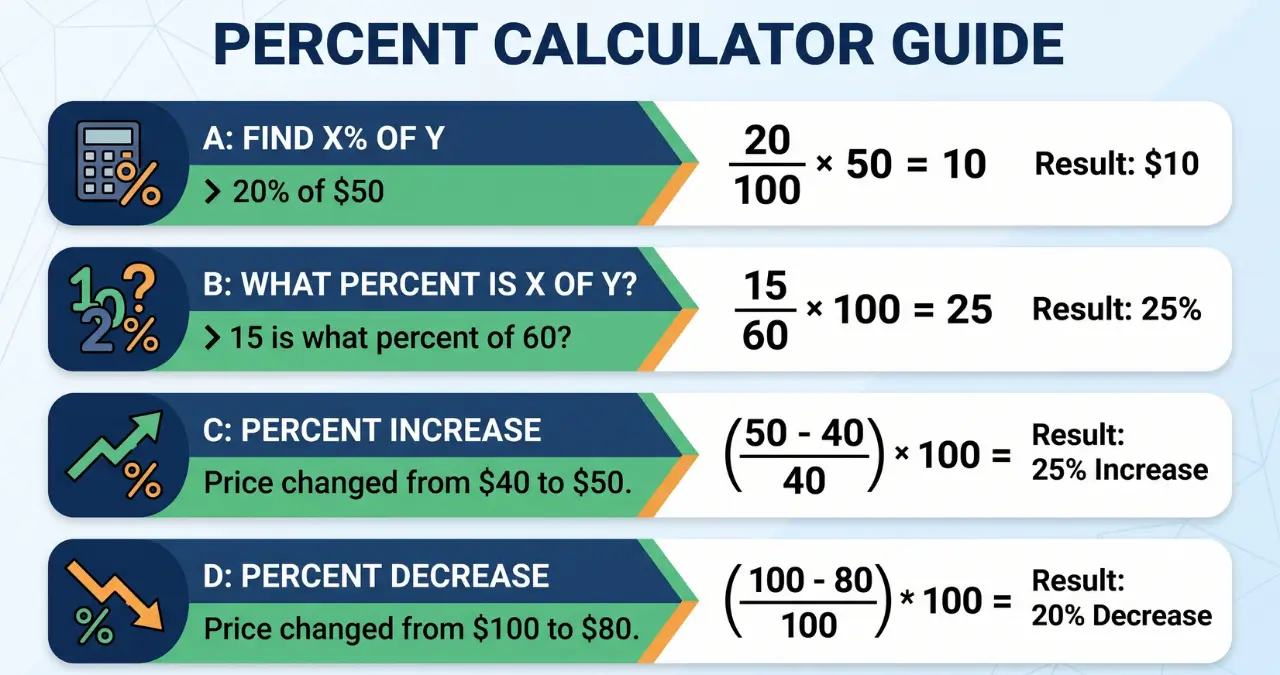
A percentage calculator makes it easy to find percentages, calculate percentage increases or decreases, and solve everyday percentage problems without doing the math manually. Whether you are checking a discount, calculating a test score, comparing prices, or working out a percentage change, the basic calculations are straightforward once you know which formula to use.
Percentages appear in many parts of everyday life. Stores use them for discounts, banks use them for interest rates, businesses use them to measure changes, and schools use them for grades and test scores.
This guide explains how percentage calculations work, which formulas to use, and how to avoid common mistakes.
What Is a Percentage Calculator?
A percentage calculator is a tool that calculates a value expressed as a percentage of another number. It can also help determine what percentage one number represents of another or measure the percentage change between two values.
The word “percent” means per hundred. For example, 25% means 25 out of 100, or 0.25 as a decimal.
A simple percentage calculation follows this formula:
Percentage = (Part ÷ Whole) × 100
For example, if you scored 45 marks out of 60:
(45 ÷ 60) × 100 = 75%
So your score is 75%.
A digital calculator can perform this calculation instantly, but understanding the formula helps you check whether an answer makes sense.
How to Use a Percentage Calculator
A percentage calculator is useful when you know the numbers involved but do not want to calculate the result manually. Most percentage problems fall into a few common categories.
Find a Percentage of a Number
To find a percentage of a number, convert the percentage to a decimal and multiply it by the number.
Formula:
Percentage value = Number × (Percentage ÷ 100)
Example:
What is 20% of 250?
250 × (20 ÷ 100) = 50
Therefore, 20% of 250 is 50.
Find What Percentage One Number Is of Another
If you want to know what percentage one number represents of another, divide the first number by the second and multiply by 100.
Formula:
Percentage = (Part ÷ Whole) × 100
Example:
A student answers 42 questions correctly out of 50.
(42 ÷ 50) × 100 = 84%
The student’s score is 84%.
Calculate Percentage Increase
Percentage increase shows how much a value has risen compared with its original value.
Formula:
Percentage Increase = ((New Value − Original Value) ÷ Original Value) × 100
For example, a product’s price increases from $80 to $100.
(($100 − $80) ÷ $80) × 100 = 25%
The price increased by 25%.
Calculate Percentage Decrease
Percentage decrease measures how much a value has fallen relative to its original amount.
Formula:
Percentage Decrease = ((Original Value − New Value) ÷ Original Value) × 100
Suppose a price falls from $200 to $150.
(($200 − $150) ÷ $200) × 100 = 25%
The price decreased by 25%.
Percentage Calculator for Discounts
A percentage calculator can quickly determine how much you save during a sale and what you actually pay after the discount.
To calculate the discount amount:
Discount = Original Price × (Discount Percentage ÷ 100)
Then:
Final Price = Original Price − Discount
For example, a $120 item has a 25% discount.
The discount is:
$120 × 0.25 = $30
The final price is:
$120 − $30 = $90
So you save $30 and pay $90.
Why Discount Percentages Can Be Misleading
A useful point to remember is that successive discounts do not simply add together.
For example, a store offering 20% off and then another 20% off does not provide a total 40% discount.
If an item costs $100:
- First 20% discount: $100 → $80
- Second 20% discount: $80 → $64
The final price is $64, meaning the total reduction is 36%, not 40%.
This distinction matters when comparing sales, coupons, and promotional offers.
Percentage Calculator for Test Scores and Grades
Percentage calculations are commonly used to convert marks into percentages. Divide the marks obtained by the total possible marks and multiply by 100.
Formula:
Percentage = (Marks Obtained ÷ Total Marks) × 100
For example, if you receive 68 marks out of 80:
(68 ÷ 80) × 100 = 85%
Your score is 85%.
The same approach works for quizzes, assignments, exams, and other situations where you know the points earned and the maximum possible points.
Keep in mind that a percentage score is not always the same as a final letter grade. Schools, colleges, and examination systems can use different grading scales.
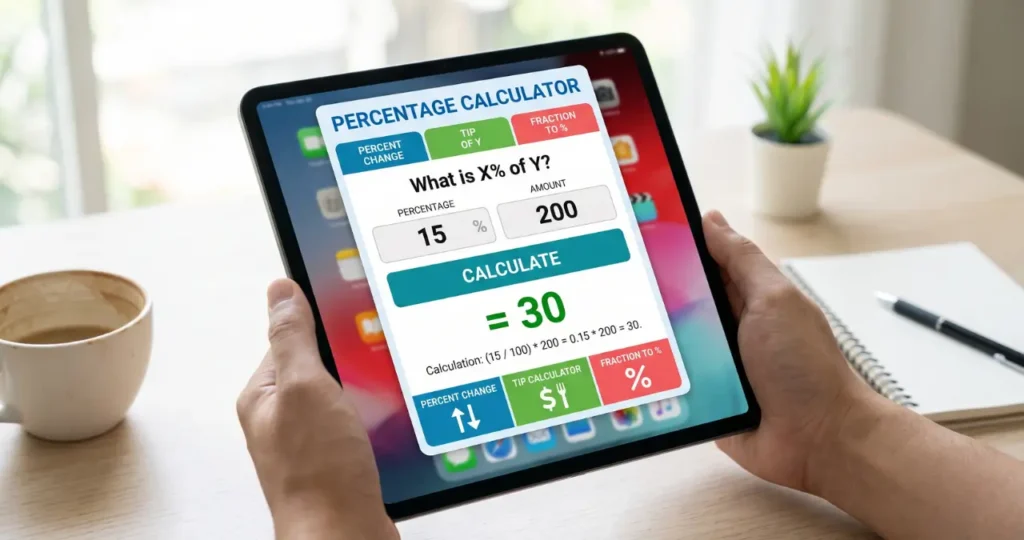
Percentage Calculator for Tax, Tips, and Fees
Percentages also help calculate taxes, tips, service charges, and other additional costs. The calculation usually starts by finding the percentage of the original amount.
For example, suppose a restaurant bill is $75 and you want to calculate a 15% tip.
$75 × 0.15 = $11.25
The tip is $11.25.
The total becomes:
$75 + $11.25 = $86.25
For taxes or fees, the same basic calculation applies. However, the exact amount you owe can depend on local rules, exemptions, rounding practices, and whether the percentage applies before or after another charge.
Percentage Calculator for Percentage Change
Percentage change is useful when comparing an old value with a new value. It tells you how large the difference is relative to the starting value.
For a change from 500 to 600:
((600 − 500) ÷ 500) × 100 = 20%
The value increased by 20%.
If it changes from 600 back to 500, the decrease is:
((600 − 500) ÷ 600) × 100 = 16.67%
This example highlights an important concept: a 20% increase followed by a 20% decrease does not return a value to its starting point.
Starting with 500:
- 20% increase → 600
- 20% decrease from 600 → 480
The final value is 480, which is 4% below the original 500.
The reason is that the second percentage uses a different starting value.
Percentage Calculator: Common Formulas
A small set of formulas covers most everyday percentage problems. Knowing which formula matches your question is more important than memorizing many variations.
| What you want to calculate | Formula |
|---|---|
| Percentage of a number | Number × Percentage ÷ 100 |
| What percentage one number is of another | Part ÷ Whole × 100 |
| Percentage increase | (Increase ÷ Original) × 100 |
| Percentage decrease | (Decrease ÷ Original) × 100 |
| Increase an amount by a percentage | Original × (1 + Percentage ÷ 100) |
| Decrease an amount by a percentage | Original × (1 − Percentage ÷ 100) |
These formulas can also be used with a standard calculator, spreadsheet, or online percentage tool.
How to Calculate Percentages Without a Calculator
You can calculate many percentages mentally by using simple fractions. This is particularly useful when you need a quick estimate.
For example:
- 50% = half
- 25% = one-quarter
- 10% = divide by 10
- 5% = half of 10%
- 1% = divide by 100
To find 15% of $200:
10% = $20
5% = $10
Therefore:
15% = $30
You can also use the relationship between percentages and decimals. Divide the percentage by 100 to convert it into a decimal.
Examples:
- 5% = 0.05
- 12% = 0.12
- 25% = 0.25
- 75% = 0.75
- 125% = 1.25
A percentage above 100% simply means the amount is greater than the original reference amount.
Common Percentage Calculation Mistakes
The most common percentage mistakes involve choosing the wrong reference number. Percentage increases and decreases should normally be measured against the original value.
For example, when a price rises from $50 to $60, the increase is $10. Dividing $10 by $60 gives 16.67%, but that is not the percentage increase. The correct calculation divides by the original $50:
$10 ÷ $50 × 100 = 20%
Another common mistake is confusing percentage points with percent change.
If an interest rate moves from 5% to 7%, the rate increased by 2 percentage points. Relative to the original 5% rate, however, that is a 40% increase.
These two measurements describe different things.
Percentage vs. Percentage Points
Percentage points measure the direct difference between two percentages. Percent change measures the relative change from the original value.
For example:
10% → 12%
The change is:
- 2 percentage points
- 20% relative increase
Both statements can be correct, but they answer different questions.
Why the Starting Value Matters
The starting value determines the denominator in most percentage-change calculations. This is one of the most important concepts to understand when comparing prices, scores, revenue, populations, or other measurements.
Consider a price that rises from $100 to $120. The increase is $20, and $20 is 20% of $100.
If the price later falls from $120 to $100, the decrease is still $20, but $20 is now 16.67% of $120.
Therefore, equal numerical changes can represent different percentages when the reference values differ.
This is why a percentage calculator needs the correct original value for increase and decrease calculations.
When Should You Use a Percentage Calculator?
A percentage calculator is helpful whenever you need a quick and accurate percentage result without manually applying a formula. Common uses include shopping discounts, exam scores, business reports, price comparisons, tips, taxes, interest calculations, and percentage changes.
For simple calculations, mental math or a standard calculator may be enough. For repeated calculations, an online tool can reduce manual work and make it easier to check different scenarios.
For important financial, academic, or business decisions, however, always verify the inputs and understand what the resulting percentage represents.
FAQ About Percentage Calculator
1. What is a percentage?
A percentage expresses a number as a fraction of 100. For example, 30% means 30 out of 100, which is equal to 0.30 as a decimal.
2. How do I calculate 10% of a number?
Divide the number by 10. For example, 10% of 350 is 35.
3. How do I calculate what percentage one number is of another?
Divide the part by the whole and multiply by 100. For example, 30 out of 40 is (30 ÷ 40) × 100 = 75%.
4. How do I calculate percentage increase?
Subtract the original value from the new value, divide the difference by the original value, and multiply by 100. This gives the percentage increase relative to the starting value.
5. How do I calculate percentage decrease?
Subtract the new value from the original value, divide the difference by the original value, and multiply by 100. The result shows how much the value decreased relative to its starting point.
6. What is 25% of 200?
Twenty-five percent of 200 is 50. You can calculate it as 200 × 25 ÷ 100 = 50.
7. Is a 20% increase followed by a 20% decrease equal to the original amount?
No. A 20% increase followed by a 20% decrease results in a value that is 4% below the original amount because the second 20% applies to the increased value.
8. What is the difference between percent and percentage points?
Percent describes relative change, while percentage points describe the direct difference between two percentages. A change from 5% to 7% is 2 percentage points but a 40% relative increase.
9. Can percentages be greater than 100%?
Yes. A percentage greater than 100% means the measured amount exceeds the reference amount. For example, 150% means one and a half times the reference value.
10. What is the easiest way to calculate a percentage?
For a quick calculation, identify what you are trying to find first: a percentage of a number, a percentage comparison, or a percentage change. Then use the matching formula and check that the result uses the correct original or whole value.